
AI Infrastructure Spending Becomes Wall Street's Biggest Theme After Big Tech Earnings
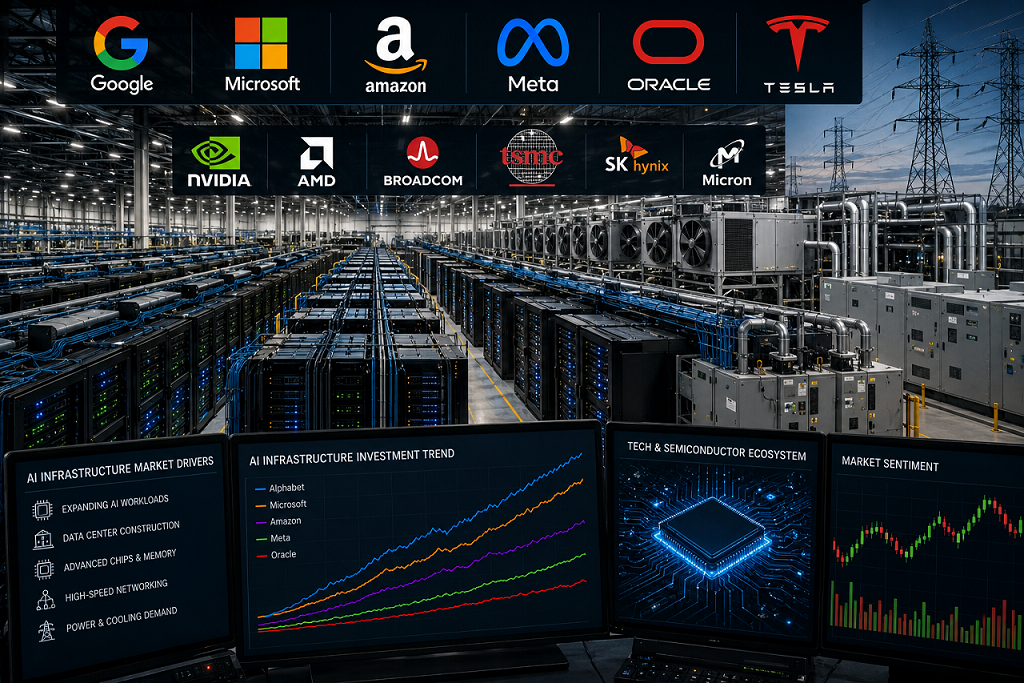
Massive AI infrastructure investments by Alphabet, Microsoft, Amazon, Meta, Oracle and Tesla have shifted investor attention from revenue growth to capital spending, free cash flow and the long-term returns on artificial intelligence.
By Vikram Singh
Key Takeaways
AI infrastructure spending has become Wall Street's primary focus during the July 2026 earnings season.
Investors are increasingly evaluating capital expenditures, free cash flow and AI monetization rather than revenue growth alone.
Hyperscalers are expected to invest roughly $534 billion in AI infrastructure between 2025 and 2027.
Semiconductor, networking and power infrastructure companies continue benefiting from record AI investment.
The debate has shifted from whether AI demand exists to whether future cash flows will justify today's unprecedented spending.
Artificial intelligence infrastructure spending has emerged as the defining theme of the July 2026 earnings season, with investors increasingly scrutinizing capital expenditures, free cash flow and returns on AI investment rather than headline revenue growth.
Recent earnings reports from Alphabet, Microsoft, Amazon, Meta Platforms, Oracle and Tesla underscore a common message: demand for artificial intelligence remains exceptionally strong, but meeting that demand requires record levels of investment in data centers, advanced chips and computing infrastructure.
According to Reuters' analysis of LSEG consensus estimates, the world's largest technology companies are expected to increase capital expenditures by approximately $534 billion between 2025 and 2027, while operating cash flow is projected to rise by about $340 billion over the same period. The figures imply roughly $1.57 of additional AI investment for every $1 of incremental operating cash flow, highlighting the capital-intensive nature of the current AI expansion.
Alphabet's latest earnings illustrated the growing tension between strong operating performance and rising investment requirements. Google Cloud revenue surged 82% year over year to approximately $24.8 billion, driven by enterprise AI adoption, but the company also raised its 2026 capital expenditure guidance to $195 billion–$205 billion from $180 billion–$190 billion. Quarterly capital expenditures nearly doubled to roughly $45 billion, prompting renewed investor concern despite robust cloud growth.
Management said additional spending is intended to relieve compute constraints as enterprise demand for AI services continues to outpace available infrastructure. Alphabet is expanding Gemini infrastructure while investing heavily in proprietary Tensor Processing Units (TPUs), making AI infrastructure its largest capital allocation priority.
Microsoft has continued expanding Azure AI capacity through additional GPU deployments and global data center investment, while Amazon Web Services remains one of the largest buyers of AI hardware worldwide as it scales generative AI services and develops custom Trainium and Inferentia processors.
Meta Platforms is pursuing one of the industry's most aggressive AI infrastructure programs, investing heavily in large AI training clusters while developing proprietary AI accelerator chips in partnership with Broadcom. Oracle has also accelerated investment in Oracle Cloud Infrastructure, with management indicating that elevated spending has pushed free cash flow into negative territory as it expands AI capacity.
The wave of infrastructure investment extends well beyond cloud providers. Tesla's latest earnings highlighted growing expenditures on Dojo computing systems, Robotaxi software and Optimus robotics, reinforcing management's position that the company is increasingly an AI and robotics business rather than solely an electric vehicle manufacturer.
These spending plans have strengthened demand across the semiconductor supply chain. Nvidia continues to dominate AI GPU shipments, while AMD expands deployments of its Instinct accelerators. TSMC remains central to manufacturing advanced AI processors, and suppliers including Broadcom, SK Hynix and Micron Technology continue benefiting from growing demand for networking silicon and High Bandwidth Memory.
The investment cycle is also reshaping adjacent industries. AI data centers require significantly more electricity, cooling and networking capacity than conventional cloud infrastructure, boosting demand for power equipment, liquid cooling systems, optical networking and industrial construction. Utilities and data center developers are increasingly seeking long-term power agreements as electricity availability becomes a growing constraint on expansion.
For investors, however, the central question has shifted from AI adoption to AI economics. Cloud revenue growth remains one of the clearest indicators of AI commercialization, but analysts are increasingly focused on whether expanding infrastructure investments will eventually translate into sustainable free cash flow and higher returns on invested capital.
The July earnings season reinforced that hyperscaler capital expenditure has become one of Wall Street's most closely watched metrics. Spending decisions by Alphabet, Microsoft, Amazon, Meta and Oracle now influence semiconductor manufacturers, networking companies, power suppliers, construction firms and real estate developers across the global technology ecosystem.
While opinions remain divided on how quickly AI investments will generate meaningful financial returns, consensus forecasts suggest infrastructure spending will remain elevated through at least 2027. For now, Wall Street appears willing to tolerate weaker near-term cash generation, provided the industry's unprecedented investment ultimately produces the productivity gains and revenue growth that companies promise.
Read More
Disclaimer
This content is for educational and informational purposes only. It is not financial advice. Stratton Journal does not recommend any specific investment or trading strategy.