


Alphabet and Tesla Earnings Shift Wall Street Focus From AI Growth to Cash Flow
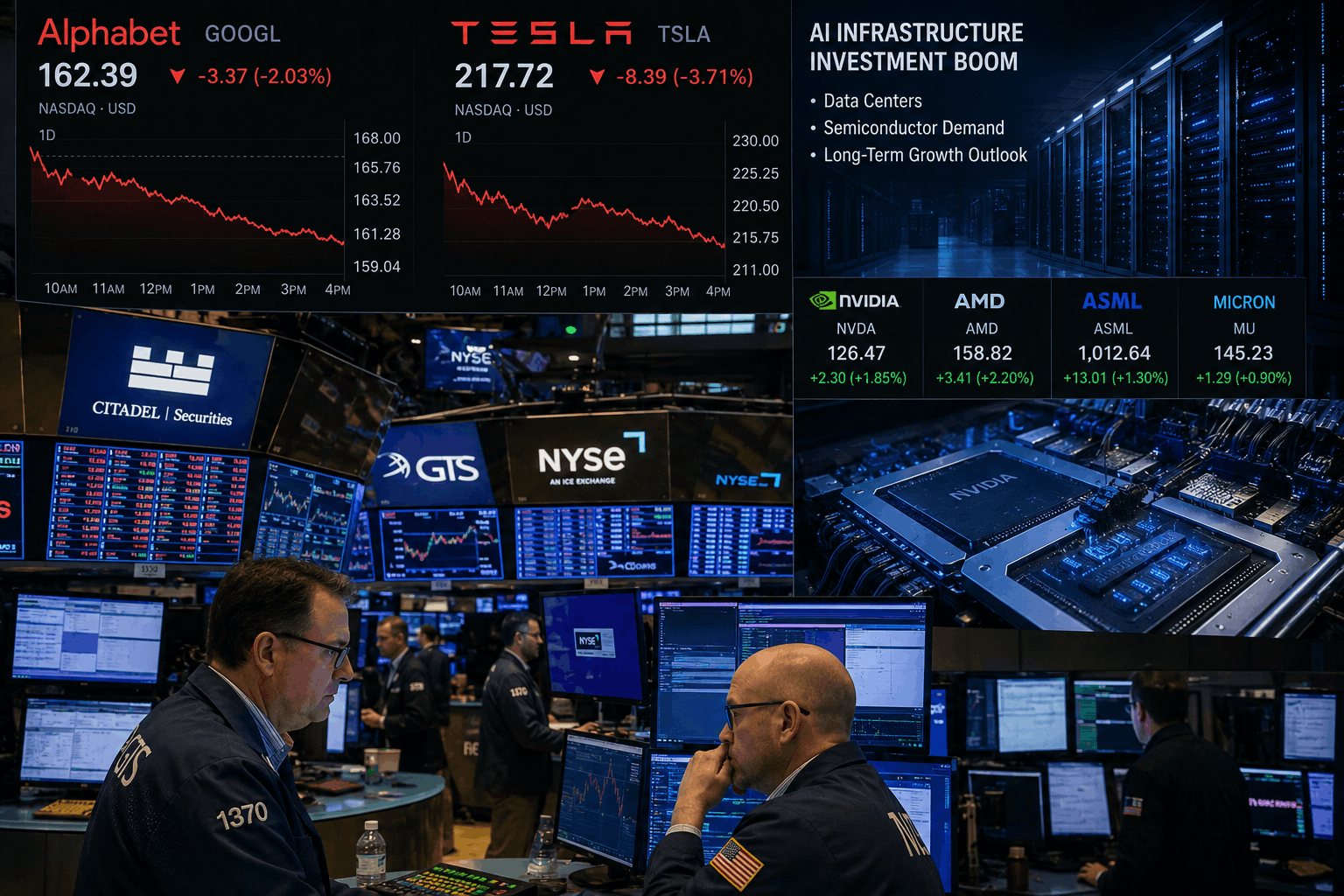
Strong revenue growth at Alphabet and continued investment by Tesla failed to reassure investors as rising AI spending, weaker free cash flow, and higher capital expenditures sparked a broad selloff in technology stocks.
Entities
Companies
Alphabet
Google Cloud
Tesla
Tickers
GOOGL
GOOG
TSLA
Industries
Technology
Cloud Computing
Artificial Intelligence
Automotive
Autonomous Driving
Semiconductor Infrastructure
Data Center Infrastructure
Technologies
Artificial Intelligence
AI Infrastructure
Data Centers
Cloud Computing
GPUs
Custom Silicon
Networking Equipment
Battery Manufacturing
Robotaxis
Autonomous Driving
Key Takeaways
Alphabet and Tesla became the first "Magnificent Seven" companies to report earnings, shifting investor attention toward AI spending and cash generation.
Alphabet reported strong revenue growth, including Google Cloud revenue growth of more than 80% year over year, but investors focused on rising capital expenditures and approximately $5.9 billion in negative free cash flow.
Tesla reported negative free cash flow for the first time in more than two years as it continued investing heavily in AI infrastructure, autonomous driving, robotaxis, and manufacturing.
Technology stocks broadly declined as investors questioned whether accelerating AI investment is producing sufficient financial returns.
The earnings season highlighted a broader shift in market priorities from revenue growth toward capital discipline, profitability, and durable cash flow.
Article
Alphabet and Tesla earnings test investor confidence in the economics of AI
The first quarterly earnings reports from the "Magnificent Seven" technology companies set the tone for earnings season by revealing a growing divide between strong business growth and investor expectations for financial discipline. Alphabet and Tesla both reported results that underscored continued investment in artificial intelligence, but the market reaction suggested investors are becoming increasingly concerned about how quickly those investments will translate into sustainable cash generation.
The earnings releases triggered a broad selloff across large-cap technology stocks and weighed on major U.S. equity indexes. While both companies emphasized long-term investments in AI infrastructure and future growth initiatives, investors focused instead on rising capital expenditures, weakening free cash flow, and the uncertain timeline for earning returns on those investments.
The market response reinforced a growing theme that has emerged as AI spending accelerates across the technology sector: strong revenue growth alone is no longer sufficient if it comes with sharply increasing capital intensity.
Alphabet delivers strong growth but investors focus on spending
Alphabet reported another quarter of robust revenue growth, with Google Cloud continuing to serve as one of the company's strongest growth engines.
Google Cloud revenue increased by more than 80% year over year, reflecting sustained enterprise demand for cloud computing services and AI-powered workloads. The performance highlighted Google's expanding role in providing the infrastructure required for artificial intelligence applications, where demand for computing capacity continues to rise rapidly.
Despite those strong operating results, investors largely overlooked the headline revenue figures.
Instead, market attention centered on Alphabet's expanding investment plans, particularly higher capital expenditures directed toward AI infrastructure.
The company continues to invest heavily in new data centers, cloud infrastructure, specialized AI hardware, computing capacity, and other systems needed to support increasingly sophisticated AI models and enterprise services.
These investments represent one of the largest capital allocation programs in Alphabet's history.
While management has consistently argued that expanding infrastructure is necessary to meet growing customer demand and maintain technological leadership, investors appeared increasingly focused on the financial consequences of those investments.
Negative free cash flow becomes the defining metric
One of the most closely watched figures in Alphabet's report was free cash flow.
Reuters reported that Alphabet generated approximately $5.9 billion in negative free cash flow, marking what Investing.com described as the first period of cash burn since the company became publicly traded.
The result shifted attention away from revenue growth toward the company's ability to convert expanding sales into available cash.
Free cash flow measures the cash a company generates after accounting for operating expenses and capital investments. It is widely viewed as an important indicator of financial flexibility because it represents resources available for dividends, share repurchases, debt reduction, acquisitions, or future investments.
Negative free cash flow does not necessarily indicate financial weakness.
Companies often experience temporary declines in free cash flow during periods of aggressive investment, particularly when constructing large infrastructure projects.
However, investors generally expect those investments to generate meaningful returns over time.
The market reaction suggested shareholders are increasingly questioning when the current wave of AI-related spending will begin producing measurable financial benefits.
Alphabet shares fell sharply following the earnings announcement as investors reassessed the balance between long-term growth opportunities and near-term financial performance.
Tesla's investment strategy also faces scrutiny
Tesla's quarterly results reflected similar concerns.
Reuters reported that Tesla generated negative free cash flow for the first time in more than two years, reinforcing investor concerns that significant investments are placing pressure on near-term cash generation.
The company attributed much of its increased spending to continued investment across several strategic priorities.
These include AI computing infrastructure, autonomous driving technology, robotaxi development, battery manufacturing, and next-generation production capabilities.
Tesla has consistently described artificial intelligence as central to its long-term strategy, arguing that autonomous driving and AI-powered transportation services represent substantial future growth opportunities.
Building those capabilities requires significant investment in computing infrastructure, software development, manufacturing facilities, and specialized hardware.
Investors, however, focused less on those long-term ambitions and more on the immediate financial impact.
Tesla shares declined more than 14% following the earnings release, making the company one of the weakest-performing large-cap stocks during the session.
The sharp decline reflected growing concerns that higher capital expenditures and weaker free cash flow could weigh on financial performance before AI-related investments begin generating significant returns.
Markets reassess the AI investment cycle
The reaction to both earnings reports highlighted an important shift in how investors evaluate technology companies.
Over the past several years, markets often rewarded rapid revenue growth and ambitious AI investment strategies with relatively little concern about near-term spending.
That approach appears to be evolving.
Reuters reported that investors are increasingly evaluating technology companies based not only on growth but also on capital discipline, profitability, operating margins, and free cash flow generation.
The emphasis has shifted toward determining whether today's AI investments will produce durable financial returns rather than simply expanding technological capabilities.
This change reflects the enormous scale of capital currently flowing into AI infrastructure.
Major technology companies are collectively investing hundreds of billions of dollars in facilities and equipment required to support increasingly powerful AI models and cloud services.
As those expenditures continue to rise, investors are demanding clearer evidence that they will translate into stronger earnings and sustainable cash generation.
AI infrastructure remains the industry's biggest spending priority
The earnings reports reinforced that AI infrastructure remains the primary destination for technology capital spending.
Across the industry, companies continue expanding data centers while investing in networking equipment, custom silicon, graphics processing units (GPUs), memory systems, storage technologies, and electrical infrastructure.
These investments support the rapidly growing computational requirements of generative AI models and enterprise AI applications.
Cloud providers also continue adding computing capacity to accommodate accelerating customer demand for AI services.
Alphabet's spending plans remain heavily concentrated in these areas as Google Cloud expands its infrastructure footprint.
Similarly, Tesla continues investing in AI computing systems designed to train autonomous driving models while expanding manufacturing capacity needed for future vehicle production.
Although the underlying technologies differ, both companies face similar financial challenges.
Large upfront investments are required today, while the timing and magnitude of future returns remain uncertain.
Wall Street shifts focus from growth to efficiency
The broader market reaction suggested that investors are entering a new phase of the AI investment cycle.
Rather than rewarding spending simply because it supports AI development, markets increasingly want evidence that management teams are deploying capital efficiently.
Revenue growth remains important, but it is no longer viewed in isolation.
Investors are increasingly evaluating whether companies can balance expansion with disciplined capital allocation.
Operating margins, cash generation, and returns on invested capital are becoming more influential in determining how earnings reports are received.
Strong sales growth may not be enough if investors conclude that infrastructure spending is expanding faster than future earnings potential.
The latest earnings season appears to reinforce that changing mindset.
Technology stocks lead broader market declines
The cautious investor response extended well beyond Alphabet and Tesla.
Technology shares broadly weakened following the earnings releases as investors reassessed valuations across AI-focused companies.
The Nasdaq Composite declined more than 2%, while the S&P 500 fell more than 1%.
Alphabet became one of the largest contributors to the S&P 500's decline because of its substantial index weighting.
Tesla also ranked among the weakest-performing large-cap stocks during the trading session.
The declines reflected concerns that other major technology companies could face similar scrutiny when they report results later in the earnings season.
Rather than concentrating solely on headline revenue growth, investors appear prepared to examine how efficiently companies convert AI investment into cash flow and long-term profitability.
The economics of AI infrastructure remain under debate
Alphabet's earnings also contributed to a broader discussion surrounding the economics of artificial intelligence infrastructure.
Developing advanced AI systems requires massive investments in computing resources, specialized processors, networking equipment, and data centers.
While demand for AI services continues expanding, the pace at which those investments generate financial returns remains uncertain.
Supporters argue that today's infrastructure spending is laying the foundation for future growth across cloud computing, enterprise software, search, automation, and digital services.
Skeptics question whether the enormous capital requirements can produce returns sufficient to justify current spending levels.
The latest earnings reports did not resolve that debate.
Instead, they reinforced that investors increasingly expect management teams to demonstrate measurable progress toward monetizing AI investments rather than relying solely on long-term strategic narratives.
Tesla's AI ambitions face similar questions
Tesla's investment strategy reflects many of the same dynamics.
The company continues directing substantial resources toward autonomous driving systems, AI computing infrastructure, robotaxi development, advanced battery production, and next-generation manufacturing technologies.
Management views these investments as critical to Tesla's long-term competitive positioning.
Investors, however, are increasingly evaluating whether the pace of spending aligns with the timing of future revenue opportunities.
Robotaxis and autonomous driving remain among Tesla's most ambitious long-term initiatives, but markets continue debating when those businesses will begin generating meaningful cash flow.
The earnings reaction suggested that shareholders may be placing greater emphasis on execution and financial discipline as investment requirements continue to grow.
What investors will watch during the remainder of earnings season
The market response to Alphabet and Tesla is likely to influence expectations for upcoming reports from other large technology companies.
Future earnings releases are expected to receive close scrutiny regarding capital expenditures, AI infrastructure investment, operating margins, and free cash flow generation.
Investors will also evaluate whether expanding AI businesses are beginning to produce measurable financial returns that justify accelerating investment.
As AI infrastructure spending continues across the technology sector, the balance between innovation and capital discipline is emerging as one of Wall Street's defining themes.
The early earnings reports from Alphabet and Tesla suggest that investors remain supportive of AI's long-term potential but are becoming increasingly selective about how companies finance that future.
For the remainder of earnings season, the key question may no longer be whether companies are investing enough in artificial intelligence, but whether they can demonstrate that those investments are creating sustainable value through stronger cash generation, improving profitability, and disciplined capital allocation.
Disclaimer
This content is for educational and informational purposes only. It is not financial advice. Stratton Journal does not recommend any specific investment or trading strategy.