
Alphabet Shares Slip After Strong Earnings as Higher AI Spending Overshadows Results
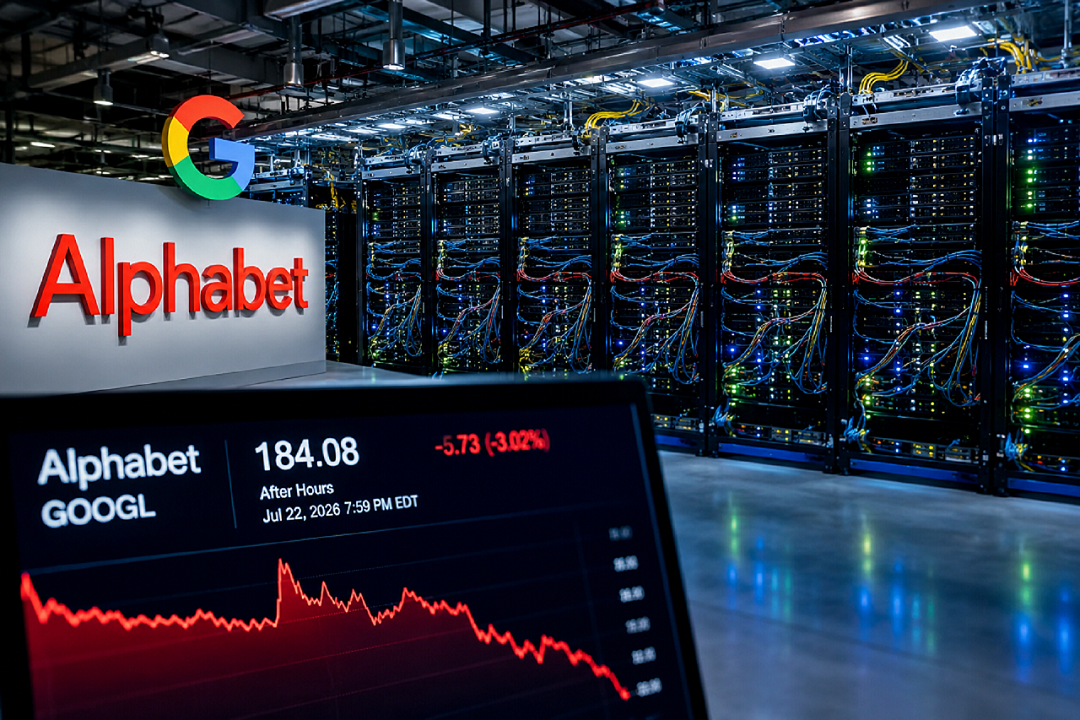
Alphabet topped Wall Street's second-quarter revenue expectations and delivered record cloud growth, but investors pushed shares lower after the company sharply increased its capital spending outlook to expand AI infrastructure.
By Vikram Singh
Key Takeaways
Alphabet exceeded Wall Street revenue expectations with 24% year-over-year growth.
Google Cloud posted record growth as enterprise AI demand accelerated.
The company raised its 2026 capital expenditure outlook to $195 billion–$205 billion.
Investors focused on higher AI infrastructure spending, sending shares lower in after-hours trading.
The results reinforced that AI monetization is improving while infrastructure investment remains elevated.
Alphabet reported stronger-than-expected second-quarter 2026 results, but the company's shares fell in after-hours trading after management significantly increased its planned spending on artificial intelligence infrastructure, highlighting investor concerns over the cost of the industry's AI expansion.
Revenue rose 24% from a year earlier to $119.8 billion, ahead of analyst expectations of roughly $117 billion, marking Alphabet's 12th consecutive quarter of double-digit revenue growth. Earnings per share came in at $9.11, while reported net income reached approximately $112.1 billion, helped by a large unrealized gain on the company's equity investments, including its stake in SpaceX.
Google Services generated $94.5 billion in revenue during the quarter. Within the segment, Google Search and related products grew 17% year over year to approximately $63.3 billion, while YouTube advertising revenue increased 13% to about $11.1 billion, reflecting continued resilience in digital advertising.
The standout performer was Google Cloud, where revenue climbed 82% year over year to $24.8 billion, its fastest recorded growth rate. The expansion was driven by enterprise demand for AI infrastructure, Google Cloud Platform services, and AI-powered business solutions as organizations accelerated deployment of generative AI applications.
Management said customer demand for AI computing continued to exceed available capacity, prompting Alphabet to further accelerate investment in data centers, servers, networking equipment, and custom AI accelerators.
Chief Financial Officer Anat Ashkenazi raised the company's 2026 capital expenditure guidance to $195 billion–$205 billion, up from its previous forecast of $180 billion–$190 billion. The revised outlook exceeded market expectations and became the dominant focus of the earnings call.
Alphabet said it will continue expanding both internally owned infrastructure and third-party computing capacity while new facilities are built. Management indicated investment would continue as long as returns remained attractive and customer demand outpaced available resources.
Quarterly capital expenditures totaled approximately $44.9 billion, nearly double the level recorded a year earlier and above quarterly operating cash flow of roughly $39.1 billion. The figures underscored the scale of Alphabet's current AI infrastructure buildout.
Despite the earnings beat, investors reacted negatively to the increased spending plans, sending Alphabet shares down about 3% in after-hours trading. The market's attention shifted from strong revenue growth toward questions about when the company's substantial AI investments will translate into higher free cash flow.
Chief Executive Officer Sundar Pichai said artificial intelligence is transforming every part of Alphabet's business, with AI integrated across Search, Workspace, Cloud, YouTube, and Android. The company's Gemini family of AI models continued expanding its reach, while enterprise adoption and developer usage also increased.
Search remained Alphabet's largest business and continued to grow despite increasing competition from AI-powered chatbots. At the same time, Google Cloud has become an increasingly important driver of growth as enterprises invest heavily in AI infrastructure and applications.
The results reinforce a broader trend across the technology sector. Investors are increasingly evaluating major cloud providers not only on revenue growth but also on how efficiently they convert massive AI infrastructure investments into sustainable earnings. Alphabet's latest quarter illustrates the growing tension between rapid AI expansion and the significant capital required to support it.
As one of the largest technology companies and a key member of the so-called "Magnificent Seven," Alphabet's spending plans are expected to influence investor expectations for upcoming earnings from other hyperscale cloud providers. The quarter also strengthens the view that enterprise demand for AI remains robust, even as the industry's investment cycle becomes increasingly capital intensive.
Disclaimer
This content is for educational and informational purposes only. It is not financial advice. Stratton Journal does not recommend any specific investment or trading strategy.