


Asian Stocks Fall as Oil Above $100 Revives Global Inflation Concerns
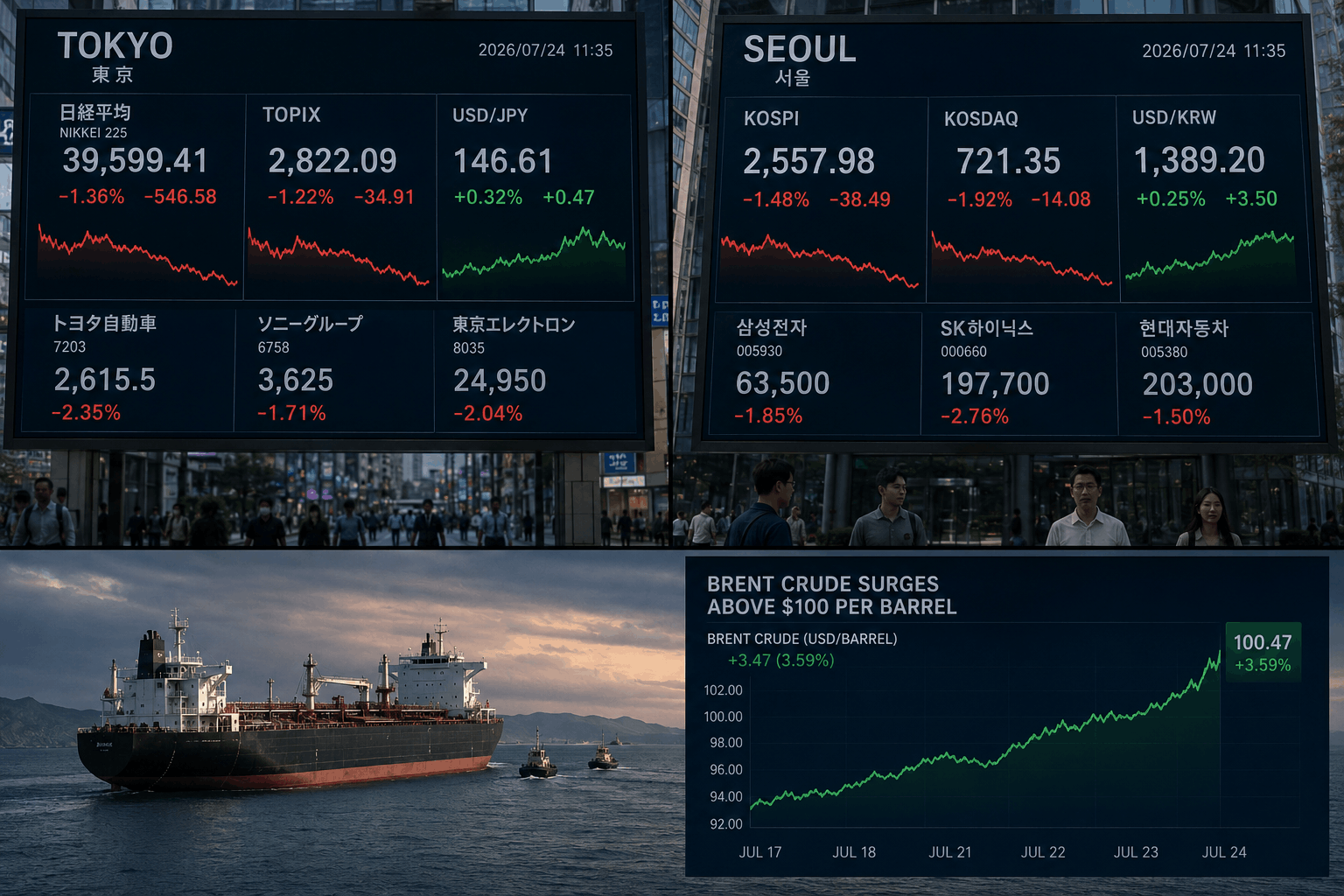
Asian equity markets declined sharply after Brent crude surged above $100 a barrel, prompting investors to reassess inflation risks, interest-rate expectations, and the broader economic impact of higher energy prices.
Entities
Companies
None
Indexes
MSCI Asia-Pacific Index (ex-Japan)
Nikkei 225
KOSPI
S&P 500 Futures
U.S. Treasury Market
Industries
Energy
Financial Markets
Transportation
Manufacturing
Shipping
Consumer Goods
Technologies
None
Key Takeaways
Asian equity markets declined after Brent crude climbed above $100 per barrel, reviving concerns about global inflation.
The oil rally followed attacks on Saudi oil tankers and continued disruption to shipping through the Strait of Hormuz and the Red Sea.
Government bond prices fell while Treasury yields rose as investors reassessed interest-rate expectations.
The U.S. dollar strengthened amid safe-haven demand, while the Japanese yen remained near a 40-year low.
Markets viewed the oil price surge as a broad macroeconomic event with implications for inflation, monetary policy, and corporate profitability.
Article
Oil shock ripples through Asian markets as inflation fears return
Asian equity markets declined sharply on Friday after Brent crude oil climbed above $100 per barrel, reigniting concerns that higher energy prices could reverse recent progress on inflation and complicate the outlook for global monetary policy.
The market selloff followed a sharp increase in crude prices triggered by attacks on Saudi oil tankers in the Red Sea and continued disruption to commercial shipping through the Strait of Hormuz. Investors responded by reducing exposure to risk assets, selling government bonds, and seeking safety in the U.S. dollar as fears of prolonged geopolitical instability spread across financial markets.
The broad reaction highlighted how rapidly an energy shock can affect multiple asset classes simultaneously, with equities, bonds, currencies, and commodities all responding to renewed concerns about inflation and global growth.
Regional stock markets retreat
Selling pressure extended across most major Asian equity markets.
MSCI's broad Asia-Pacific share index outside Japan declined about 1%, reflecting widespread weakness across the region.
Japan's Nikkei 225 fell approximately 2.9%, while South Korea's KOSPI dropped roughly 3.7%, making it one of the region's weakest-performing major markets.
The declines followed weakness on Wall Street, where investors had already begun reassessing the implications of higher energy prices alongside disappointing sentiment surrounding major technology earnings.
U.S. equity futures also traded lower during Asian hours, suggesting investors remained cautious about the potential economic consequences of rising oil prices.
Rather than reflecting concerns about individual sectors or companies, the selloff represented a broad reduction in risk exposure as markets reassessed the macroeconomic outlook.
Brent's move above $100 becomes the market's focal point
Energy markets remained at the center of investor attention.
Brent crude traded around $100.85 per barrel after surging roughly 7% during the previous session. During overnight trading, the international benchmark briefly reached approximately $102 per barrel, its highest level in about two months.
The rally was driven primarily by escalating tensions in the Middle East.
Attacks on Saudi oil tankers in the Red Sea and continued disruption affecting shipping through the Strait of Hormuz heightened concerns that global energy supplies could face prolonged logistical challenges.
Although no widespread production outages have been reported, markets increasingly priced in the possibility that transportation disruptions alone could tighten available supplies and increase delivery costs.
The move above the psychologically important $100 threshold also amplified investor concerns, drawing attention to the broader economic implications of sustained high energy prices.
Shipping disruptions raise supply concerns
The latest rise in crude prices reflected growing concerns about the security of two of the world's most important maritime energy corridors.
The Strait of Hormuz handles roughly one-fifth of globally traded crude oil, making it a critical route for energy exports from the Persian Gulf.
At the same time, the Red Sea provides an important alternative shipping corridor through the Bab el-Mandeb Strait and the Suez Canal.
Disruptions affecting either route can increase transportation costs and delay deliveries.
Concerns become even more significant when both shipping corridors face heightened security risks simultaneously.
Commercial shipping companies have already begun reassessing routes, while higher marine insurance costs and longer voyage times have increased overall transportation expenses.
These logistical risks contribute to higher oil prices even without an immediate reduction in global production.
Inflation fears return to the forefront
The latest increase in crude prices reversed part of the decline in energy costs that had recently helped ease inflation pressures in many economies.
Higher oil prices can influence inflation through multiple channels.
More expensive crude generally leads to higher gasoline and diesel prices, increasing transportation costs for businesses and households alike.
Manufacturers also face higher input costs for production and distribution, while airlines, shipping companies, and logistics providers typically experience rising fuel expenses.
Many businesses eventually pass those higher costs to consumers, contributing to broader increases in consumer prices.
As a result, energy prices remain one of the most closely watched components of headline inflation measures used by central banks around the world.
The market's reaction reflected concern that a sustained increase in oil prices could delay progress toward inflation targets.
Bond markets respond to shifting expectations
The inflation concerns quickly spread into fixed-income markets.
Government bond prices declined as investors sold longer-duration securities, pushing yields higher.
U.S. Treasury yields rose during the session, with long-dated yields approaching some of their highest levels in many years as investors priced in the possibility that inflation could remain elevated for longer than previously expected.
Bond yields typically rise when markets expect central banks to maintain higher interest rates or delay planned monetary easing.
The renewed increase in energy prices prompted investors to reconsider assumptions that inflation would continue moderating over coming months.
Instead, markets increasingly questioned whether policymakers would have sufficient confidence to reduce borrowing costs if oil prices remain elevated.
The synchronized movement in both equity and bond markets reflected a common concern: higher energy prices could keep financial conditions tighter for longer.
Central-bank expectations shift
The oil rally also altered expectations for future monetary policy.
Before the latest increase in crude prices, investors had become increasingly optimistic that easing inflation would give central banks greater flexibility to lower interest rates.
The resurgence in energy prices complicated that outlook.
Although central banks generally look beyond temporary swings in commodity prices, sustained increases in fuel costs can eventually affect broader inflation measures.
If businesses begin passing higher transportation and manufacturing expenses to consumers, underlying inflation pressures could prove more persistent.
That possibility led markets to reduce expectations for near-term policy easing in several major economies.
Investors will continue monitoring whether the current oil rally proves temporary or develops into a longer-lasting trend capable of influencing inflation data over coming months.
Currency markets reflect safe-haven demand
The shift toward caution was also evident in foreign exchange markets.
The U.S. dollar strengthened as investors sought traditional safe-haven assets amid heightened geopolitical uncertainty.
Periods of elevated global risk often increase demand for dollar-denominated assets because of the currency's central role in international finance and global reserve holdings.
Meanwhile, the Japanese yen remained near a 40-year low against the dollar.
Ordinarily, the yen tends to benefit during periods of market stress because of its traditional safe-haven status.
However, persistent differences in monetary policy and interest-rate expectations have continued to weigh on Japan's currency.
The combination of geopolitical uncertainty and yen weakness added another layer of concern for Japanese financial markets.
A weaker yen can increase import costs, particularly for energy, placing additional pressure on inflation in an economy that imports most of its oil and natural gas.
Asian economies face differing impacts
The consequences of higher oil prices vary across Asia.
Energy-importing economies generally face rising production costs, weaker consumer purchasing power, and potential pressure on trade balances as fuel imports become more expensive.
Export-oriented manufacturers may also experience margin pressure if higher transportation and logistics costs cannot be fully passed on to customers.
Conversely, countries with greater exposure to energy production may benefit from stronger commodity prices.
Currency movements also influence how individual economies experience higher oil prices.
A stronger U.S. dollar increases the local-currency cost of imported energy for many countries, amplifying the inflationary impact of rising crude prices.
As a result, investors increasingly evaluate oil prices alongside exchange-rate movements when assessing regional economic prospects.
Markets interpret oil as a macroeconomic event
One notable feature of Friday's trading session was the breadth of the market reaction.
Rather than treating higher oil prices as an isolated development affecting only energy companies, investors interpreted the rally as a broader macroeconomic event.
Oil, government bonds, equities, and currencies all moved in a consistent risk-off direction.
The simultaneous decline in stock prices, rise in bond yields, appreciation of the dollar, and increase in crude prices reflected a common reassessment of inflation risks.
The move was not driven by new economic data releases or changes in corporate fundamentals.
Instead, the catalyst was geopolitical developments affecting global energy transportation.
That distinction underscores how supply-side shocks can rapidly reshape market expectations across multiple asset classes.
Broader geopolitical backdrop remains in focus
Investors continued monitoring a range of geopolitical and economic developments beyond energy markets.
These included ongoing conflict in the Middle East, disruptions to key global oil supply routes, and recently announced U.S. tariff measures affecting dozens of trading partners.
Markets also remained focused on the early stages of the corporate earnings season, particularly reports from major technology companies, while evaluating how global economic conditions could influence future central-bank decisions.
The combination of geopolitical uncertainty, trade developments, and earnings results contributed to an already cautious investment environment before the latest surge in oil prices.
The energy shock intensified those concerns by introducing renewed uncertainty about inflation and monetary policy.
What investors will watch next
The durability of the current market reaction will largely depend on whether elevated oil prices persist.
Investors are expected to closely monitor Brent crude futures, developments affecting shipping through the Strait of Hormuz and the Red Sea, and any further disruptions to global energy transportation.
Attention will also remain on government bond yields, the U.S. dollar, and the Japanese yen, all of which have become key indicators of broader market sentiment.
Upcoming inflation reports, central-bank communications, and corporate earnings will provide additional insight into how businesses and policymakers are responding to the renewed rise in energy costs.
For now, the market's message is clear: oil's return above $100 has reintroduced inflation as a central concern for global investors.
The synchronized movements across commodities, equities, bonds, and currencies demonstrate how quickly geopolitical events affecting energy markets can reshape financial expectations, influencing everything from interest-rate forecasts to corporate profitability and consumer spending.
Disclaimer
This content is for educational and informational purposes only. It is not financial advice. Stratton Journal does not recommend any specific investment or trading strategy.