


Brent Crude Surges Above $100 as Middle East Shipping Risks Jolt Global Oil Markets
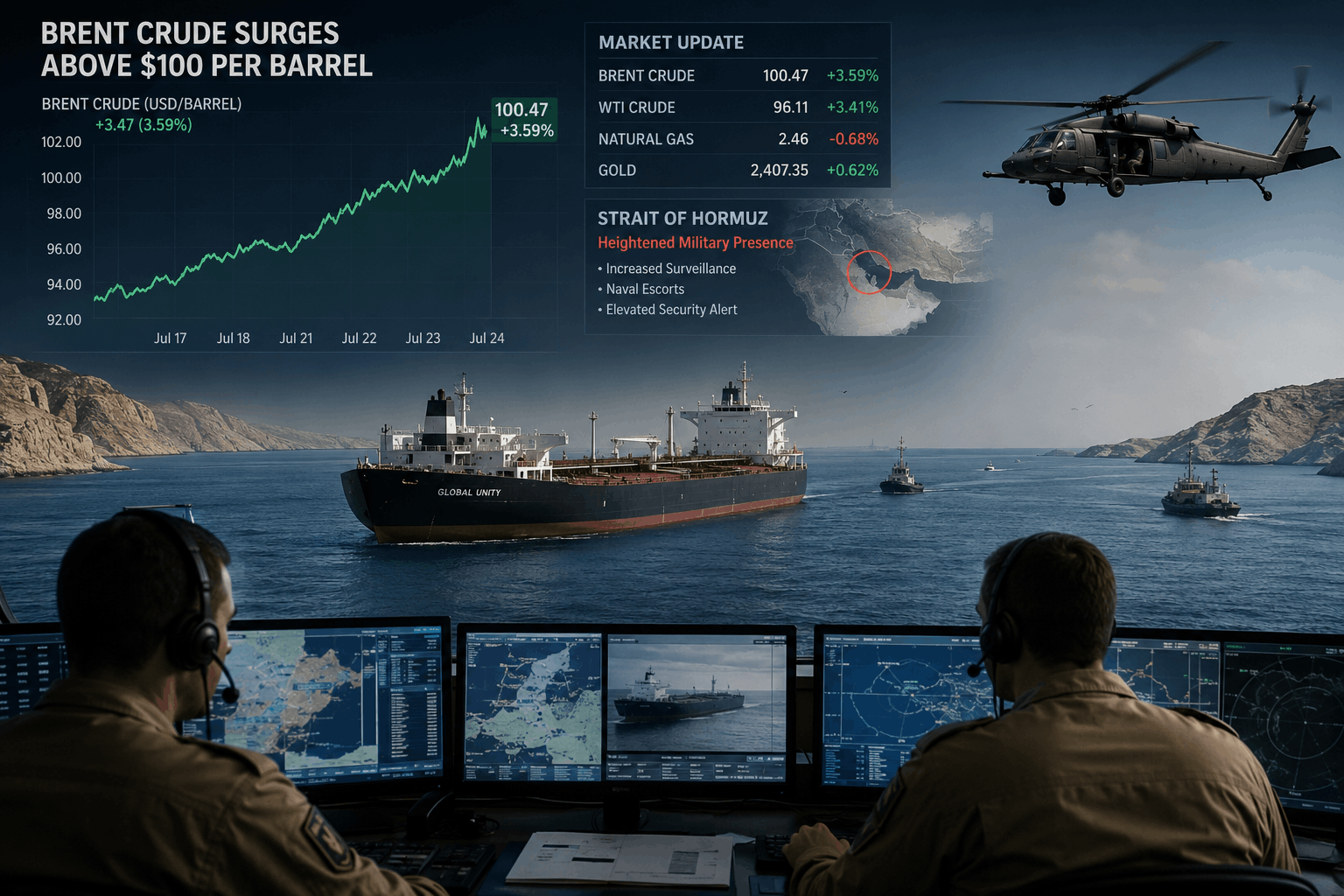
Brent crude closed above $100 a barrel for the first time since May after attacks on Saudi oil tankers, reduced traffic through the Strait of Hormuz, and new supply concerns from Kazakhstan intensified fears of broader disruptions to global energy flows.
Entities
Companies
Saudi Aramco
Caspian Pipeline Consortium
Tickers
Brent Crude
WTI Crude
Industries
Oil & Gas
Energy
Shipping
Marine Insurance
Airlines
Transportation
Chemicals
Oilfield Services
Technologies
Offshore oil transportation
Pipeline infrastructure
Marine logistics
Key Takeaways
Brent crude settled above $100 per barrel for the first time since May as geopolitical tensions disrupted key oil shipping routes.
Attacks on Saudi oil tankers and sharply reduced traffic through the Strait of Hormuz heightened fears of prolonged supply disruptions.
Additional supply concerns emerged after Kazakhstan reduced exports following damage to critical infrastructure.
Markets reacted primarily to transportation and security risks rather than confirmed production losses.
Sustained higher oil prices could add inflationary pressure while benefiting energy producers and increasing costs for transportation-intensive industries.
Article
Brent climbs above $100 as geopolitical tensions threaten global oil supplies
Brent crude oil settled above $100 per barrel on July 24 for the first time since late May, as escalating geopolitical tensions across the Middle East heightened concerns that two of the world's most important oil shipping corridors could face prolonged disruption.
Brent crude finished the session at approximately $100.69 per barrel, while U.S. benchmark West Texas Intermediate (WTI) settled near $92.19 per barrel. Brent gained roughly 7% during the trading session, extending its rally to a fifth consecutive day and lifting its weekly advance to about 14.6%. WTI rose approximately 11.8% over the week.
The sharp move reflected growing concern that the security environment surrounding global oil transportation has deteriorated significantly, even though there has not yet been a widespread interruption in oil production itself.
Tanker attacks expand concerns beyond the Strait of Hormuz
The immediate catalyst for the latest rally was a series of attacks on two Saudi oil tankers in the Red Sea, with Yemen's Houthi movement claiming responsibility.
The attacks added a new dimension to an already fragile energy market.
For months, investors had focused primarily on the Strait of Hormuz, the narrow waterway connecting the Persian Gulf with international markets. The latest incident suggested that risks are no longer confined to a single shipping route.
Instead, traders increasingly fear simultaneous disruptions affecting both the Strait of Hormuz and the Red Sea—two corridors that together handle a substantial share of global crude exports.
The attacks also prompted commercial shipping companies to reassess voyage plans, while marine insurance premiums reportedly increased sharply as insurers incorporated higher geopolitical risks into coverage costs.
Several commercial vessels altered or delayed planned routes following the attacks, highlighting the rapidly changing security environment.
Hormuz traffic falls sharply
Concerns intensified after commercial tanker activity through the Strait of Hormuz slowed dramatically.
Only one crude tanker reportedly crossed the strait on July 23, marking the lowest level of tanker traffic since early May.
Although temporary fluctuations in shipping volumes are not uncommon, the decline reinforced investor concerns that security threats could increasingly discourage commercial operators from using one of the world's most strategically important maritime passages.
The Strait of Hormuz carries roughly one-fifth of globally traded crude oil, making it one of the most critical chokepoints in the international energy system.
Any sustained reduction in tanker traffic through the strait has the potential to delay cargo deliveries, tighten available supplies, and increase transportation costs for refiners around the world.
While no formal closure of the waterway has occurred, the reduction in shipping activity alone was sufficient to increase market anxiety.
Red Sea becomes a second strategic chokepoint
The latest attacks also highlighted the growing strategic importance of the Red Sea.
When conditions permit, many cargoes transit through the Bab el-Mandeb Strait before moving north toward the Suez Canal, providing an important alternative route for oil shipments leaving the Gulf.
If both the Strait of Hormuz and the Red Sea face security disruptions simultaneously, shipping companies may be forced to reroute vessels around the Cape of Good Hope at the southern tip of Africa.
Such diversions can extend voyages by several weeks while increasing fuel consumption, charter costs, crew expenses, and delivery times.
Longer shipping routes also reduce the effective availability of tanker fleets because vessels remain at sea for extended periods before returning for additional cargoes.
Even if crude production remains unchanged, logistical bottlenecks can tighten market conditions by slowing the movement of oil from producers to refiners.
Kazakhstan adds another supply concern
At the same time, markets were monitoring an unrelated supply issue involving Kazakhstan.
Oil production in Kazakhstan declined after Ukrainian drone attacks affected export infrastructure connected to the Caspian Pipeline Consortium.
The pipeline system temporarily halted operations, disrupting an export route that accounts for roughly 2% of global crude supply.
One of Kazakhstan's largest producing fields reportedly reduced output by more than half following the disruption, adding another layer of uncertainty to already nervous energy markets.
Although Kazakhstan's production issues alone would likely not have pushed Brent above $100, they reinforced broader concerns that multiple supply challenges could emerge simultaneously.
Markets price future risk rather than current shortages
The latest rally illustrates an important feature of oil markets: prices often react to expectations rather than confirmed shortages.
At present, there is little evidence of widespread production losses across the Middle East.
Instead, traders are assigning higher probabilities to scenarios involving delayed deliveries, transportation disruptions, elevated insurance costs, and logistical complications.
As those risks increase, futures prices generally rise to reflect the possibility that physical supplies could become more difficult or expensive to obtain.
Transportation risk can have a meaningful impact on crude prices even when production remains largely intact.
If refiners anticipate delivery delays or higher shipping expenses, they may be willing to pay more for available supplies today rather than risk shortages later.
This risk premium has become an increasingly important component of oil pricing during periods of geopolitical instability.
Saudi Aramco explores alternative export options
Shipping disruptions have also encouraged exporters to seek operational alternatives.
Saudi Aramco began offering certain crude cargoes through Egypt's Sidi Kerir terminal, providing an alternative loading point that may help reduce dependence on routes facing heightened security risks.
The move reflects broader efforts across the industry to preserve export flexibility as military tensions evolve.
Alternative export arrangements can help mitigate some logistical challenges, although they are unlikely to fully replace the capacity provided by the Strait of Hormuz under normal operating conditions.
Political tensions remain elevated
Geopolitical tensions escalated further after U.S. President Donald Trump threatened significant military retaliation against Iran and Houthi forces following the tanker attacks.
Iran warned that additional military action could trigger further retaliation, increasing concerns that the conflict could spread across a broader portion of the Middle East.
For energy markets, the possibility of prolonged instability matters as much as immediate physical disruptions.
Extended geopolitical uncertainty can influence shipping decisions, insurance pricing, investment planning, and commercial inventories long before any actual reduction in oil production occurs.
Inflation implications extend beyond energy markets
Higher crude prices have consequences that extend well beyond oil producers.
Crude oil serves as the primary input for gasoline, diesel, jet fuel, and numerous petrochemical products used throughout the global economy.
If elevated crude prices persist, consumers could eventually experience higher fuel prices, while businesses may face increased transportation, freight, and manufacturing costs.
Those higher costs can gradually feed into broader measures of consumer inflation.
Energy prices represent a significant component of headline inflation indicators monitored closely by central banks.
A sustained increase in oil prices could complicate efforts by policymakers to return inflation toward target levels.
Should energy-driven inflation prove persistent, expectations for future interest-rate cuts could be delayed, particularly if rising fuel costs begin affecting broader price measures.
Winners and losers across financial markets
Higher oil prices tend to create divergent outcomes across sectors.
Oil producers, exploration companies, oilfield service providers, and pipeline operators generally benefit from stronger crude prices because higher benchmark prices can improve revenue and profitability.
Conversely, industries with significant fuel consumption—including airlines, cruise operators, freight companies, logistics firms, and parts of the chemicals sector—often face increased operating expenses when oil prices rise sharply.
Consumer discretionary businesses may also experience indirect pressure if households devote more income to energy costs.
Financial markets also monitor the broader macroeconomic implications.
Periods of elevated geopolitical uncertainty frequently increase demand for the U.S. dollar as a traditional safe-haven asset.
At the same time, rising inflation expectations can place upward pressure on U.S. Treasury yields if investors conclude that monetary policy may need to remain restrictive for longer.
Gold often benefits from geopolitical uncertainty, although gains can be moderated if higher real yields strengthen the dollar.
Oil above $100 carries psychological significance
Brent's return above the $100 threshold is symbolically important as well as economically meaningful.
Historically, triple-digit oil prices have often coincided with periods of significant geopolitical stress, including Russia's invasion of Ukraine, major Middle East conflicts, severe supply disruptions, and periods of aggressive production restraint by major oil exporters.
While the $100 level has no direct economic significance, it represents an important psychological benchmark that often attracts increased attention from governments, policymakers, businesses, and financial markets.
Crossing that threshold can also influence inflation expectations and corporate planning decisions, particularly for industries that rely heavily on fuel.
What markets will watch next
Investors are expected to closely monitor developments across several fronts in the coming weeks.
Particular attention will remain focused on whether additional attacks target commercial shipping, whether tanker traffic through the Strait of Hormuz begins to recover, and whether security conditions improve in the Bab el-Mandeb Strait.
Markets will also assess marine insurance costs, global refinery operations, and any further supply disruptions affecting Kazakhstan or other major exporters.
In addition, traders will watch upcoming OPEC+ production decisions, U.S. Energy Information Administration inventory data, Federal Reserve communications, inflation reports, and diplomatic developments involving the United States, Iran, Saudi Arabia, and Houthi forces.
The direction of crude prices is likely to depend not only on actual supply disruptions but also on how markets continue to evaluate the evolving balance between geopolitical risk, transportation security, and global oil availability.
Disclaimer
This content is for educational and informational purposes only. It is not financial advice. Stratton Journal does not recommend any specific investment or trading strategy.