


Deckers Raises Annual Profit Forecast After HOKA Strength Drives First-Quarter Earnings Beat
Deckers Outdoor lifted its fiscal 2027 earnings outlook after stronger-than-expected first-quarter profits, but shares fell in after-hours trading as investors sought a larger guidance increase and stronger sales expectations.
By Vikram Singh
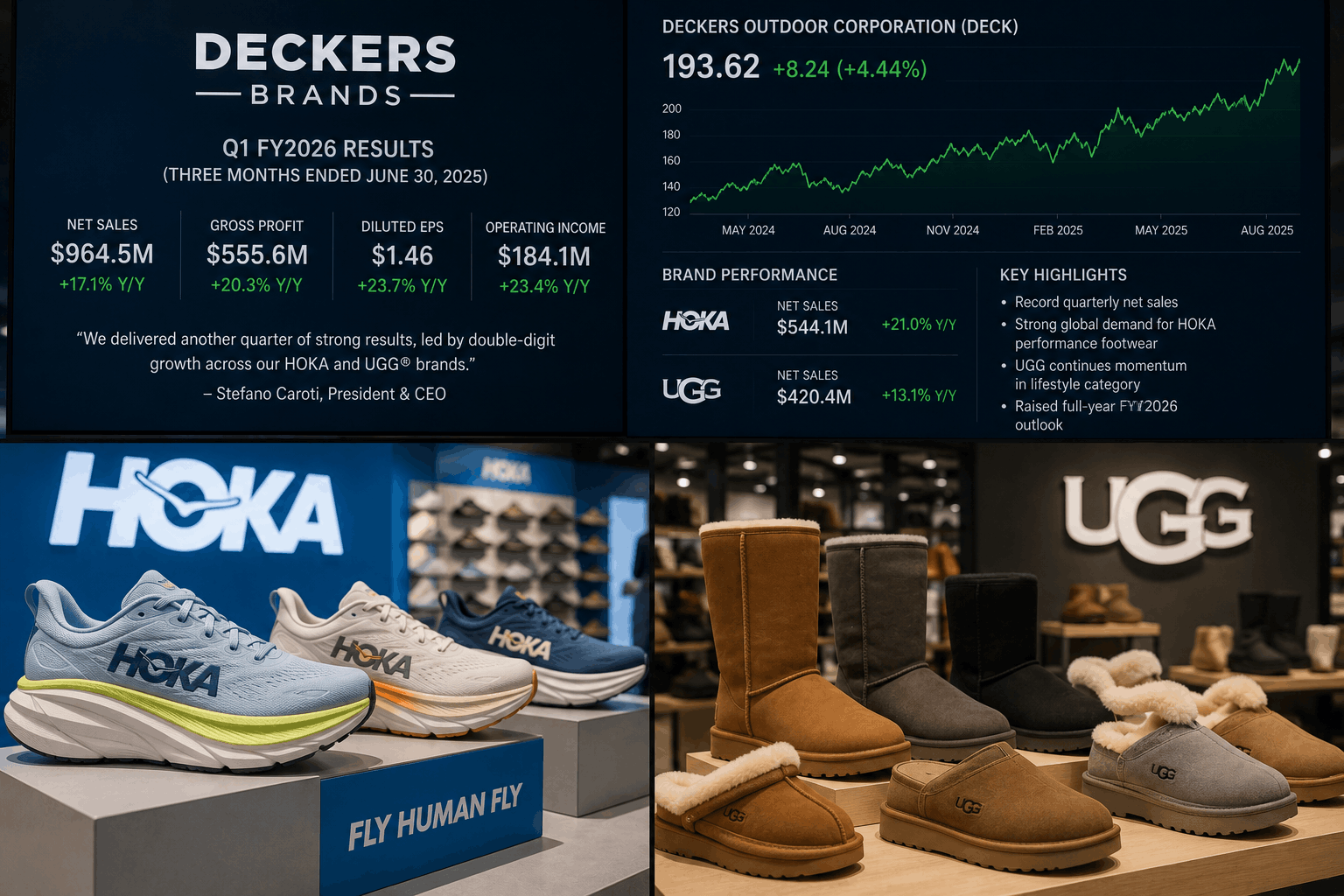
Key Takeaways
Deckers reported first-quarter earnings that exceeded Wall Street's profit expectations and raised its fiscal 2027 earnings outlook.
Continued demand for HOKA running shoes and UGG footwear, together with growth in the direct-to-consumer business, supported quarterly profitability.
The company maintained its annual sales guidance despite lifting its earnings forecast and improving margin expectations.
Investors viewed the increase in annual earnings guidance as modest, sending shares about 8% lower in after-hours trading.
Markets remain focused on consumer demand, margin performance, and the sustainability of growth in the premium footwear segment.
Article
Deckers beats earnings expectations but cautious outlook disappoints investors
Deckers Outdoor reported stronger-than-expected fiscal first-quarter earnings and modestly increased its full-year profit outlook, reflecting continued demand for its HOKA and UGG brands and ongoing strength in its direct-to-consumer business.
Despite the earnings beat, investors reacted negatively after the footwear company left its annual sales forecast unchanged and raised earnings guidance by only a small amount. Reuters reported that Deckers shares fell about 8% in after-hours trading, suggesting the market had anticipated a more significant improvement in the company's outlook.
The results illustrate the increasingly demanding environment facing consumer companies, where strong operating performance alone may not be sufficient if future guidance falls short of elevated investor expectations.
First-quarter earnings exceed Wall Street estimates
For the fiscal first quarter ended June 30, 2026, Deckers reported revenue of $1.02 billion and diluted earnings per share of $0.94.
According to Reuters, quarterly revenue was broadly in line with Wall Street expectations, while earnings per share exceeded analyst estimates.
The stronger profitability reflected continued demand across the company's major brands together with the growing contribution of its higher-margin direct-to-consumer operations.
Although revenue growth remained solid, investors appeared to place greater emphasis on management's outlook for the remainder of the fiscal year than on the quarterly earnings beat itself.
The reaction highlights a recurring theme during the current earnings season: financial markets are increasingly focused on future growth prospects rather than historical performance.
Company raises annual earnings guidance
Following the stronger quarter, Deckers increased its fiscal 2027 diluted earnings per share guidance.
The company now expects annual diluted EPS between $7.35 and $7.50, compared with its previous forecast of $7.30 to $7.45.
While the revision reflects increased confidence in profitability, the change was relatively modest.
At the midpoint, annual earnings guidance increased by approximately $0.05 per share.
The limited size of the upward revision became one of the primary reasons investors reacted cautiously despite the company's strong quarterly performance.
Markets often compare updated guidance not only with previous company forecasts but also with broader investor expectations regarding future growth.
In this case, the modest increase appears to have fallen short of what some investors anticipated following the earnings beat.
Sales outlook remains unchanged
Unlike its profit forecast, Deckers maintained its fiscal 2027 net sales guidance.
The company continues to expect annual revenue between $5.86 billion and $5.91 billion.
Leaving revenue guidance unchanged suggested management remains cautious regarding the broader consumer spending environment despite strong demand for its leading brands.
The decision also indicated that improved profitability is expected to come primarily from operational execution and margin performance rather than materially faster sales growth.
Maintaining sales guidance while increasing earnings expectations generally implies management expects improved efficiency, better product mix, or stronger cost control.
Nevertheless, investors often prefer simultaneous increases in both revenue and earnings forecasts during periods of strong consumer demand.
HOKA continues driving growth
One of the company's most important growth engines remained the HOKA brand.
Reuters reported that continued consumer demand for HOKA running shoes contributed significantly to quarterly performance.
Originally known within the specialty running market, HOKA has expanded rapidly into broader athletic footwear categories as consumers increasingly seek performance-oriented products.
The brand has benefited from growing interest in running, walking, fitness, and premium athletic footwear, allowing Deckers to attract customers across multiple demographic groups.
New product introductions also supported demand during the quarter.
Expanding product offerings helps footwear companies maintain consumer engagement while encouraging repeat purchases and attracting new customers.
The continued strength of HOKA reinforces its importance as one of the fastest-growing assets within Deckers' portfolio.
UGG remains a key contributor
The UGG brand also continued supporting company performance.
Although historically associated with seasonal footwear, UGG has expanded into a broader lifestyle brand with products extending beyond its traditional winter offerings.
Reuters reported that ongoing consumer demand for UGG products contributed positively during the quarter.
The combination of HOKA's athletic positioning and UGG's lifestyle appeal provides Deckers with exposure to multiple segments of the premium footwear market.
Maintaining momentum across both brands has become increasingly important as consumer discretionary spending remains uneven in many regions.
The company's ability to generate demand across distinct product categories has helped support overall financial performance.
Direct-to-consumer business strengthens profitability
Another important contributor to quarterly results was continued expansion of Deckers' direct-to-consumer (DTC) business.
Reuters highlighted that the company's higher-margin DTC operations continued supporting profitability during the quarter.
Selling products directly through company-operated stores and digital channels generally produces higher margins than traditional wholesale distribution because retailers do not share as much of the sales value with third-party partners.
In addition to stronger profitability, direct relationships with consumers provide companies with better access to purchasing data, customer preferences, and brand engagement.
Deckers said both wholesale distribution and direct-to-consumer channels contributed positively during the quarter.
The balanced performance across both channels suggests the company continues expanding its retail presence while maintaining productive wholesale partnerships.
Premium positioning helps navigate consumer uncertainty
Reuters noted that Deckers has continued attracting higher-income consumers despite broader economic pressures affecting discretionary spending.
Premium brands often demonstrate greater resilience during periods of economic uncertainty because higher-income households tend to be less sensitive to inflation and slowing economic growth.
The company's emphasis on performance footwear and premium lifestyle products has allowed it to maintain pricing discipline while supporting brand value.
At the same time, consumers remain increasingly selective in discretionary purchases.
Footwear companies therefore continue balancing premium pricing with product innovation and marketing investment to sustain demand.
Deckers' latest results suggest its leading brands remain well positioned within that competitive environment.
Margin outlook improves
Alongside higher earnings guidance, Deckers also updated several profitability expectations.
The company now expects fiscal 2027 gross margin to be slightly better than 56.5%.
Operating margin is projected to be slightly better than 21.5%.
The effective tax rate remains expected to be approximately 23%.
Improving gross margin indicates management expects favorable product mix, pricing, or cost trends to support profitability throughout the year.
Operating margin measures how efficiently a company converts revenue into operating income after accounting for selling, administrative, and other operating expenses.
Higher operating margins generally reflect improved efficiency and stronger earnings quality.
These updated forecasts suggest management remains confident in its ability to protect profitability even amid broader uncertainty affecting consumer markets.
Market focuses on expectations rather than results
The after-hours decline illustrates how investor expectations influence earnings reactions.
Although Deckers exceeded quarterly profit forecasts and increased its full-year earnings outlook, markets judged the improvements against already elevated expectations.
Reuters reported that investors focused on two factors.
First, the increase in annual earnings guidance amounted to only about $0.05 at the midpoint.
Second, annual sales guidance remained unchanged.
Together, those factors suggested future growth may not accelerate as much as some investors had anticipated.
The market response demonstrates that earnings season often depends as much on future expectations as on reported financial performance.
Consumer environment remains closely watched
Deckers continues operating within a consumer environment shaped by several competing forces.
Higher-income consumers have generally remained relatively resilient despite broader economic uncertainty.
However, inflation, tariffs, freight expenses, and changing consumer spending patterns continue influencing purchasing decisions across the retail sector.
Premium footwear companies must also balance inventory management, pricing, product innovation, and marketing investment while responding to evolving fashion trends.
Strong brand positioning has helped companies like Deckers outperform many traditional apparel retailers, but sustaining that momentum requires continued execution.
The company's updated outlook reflects confidence in profitability while acknowledging ongoing uncertainty surrounding broader consumer demand.
What investors will watch next
Investors will closely monitor demand for both HOKA and UGG products during the remainder of fiscal 2027.
Continued expansion of the direct-to-consumer business will remain another important indicator because of its higher contribution to overall profitability.
Markets will also evaluate whether Deckers can achieve its updated earnings guidance while maintaining gross and operating margin improvements.
External factors—including tariffs, freight costs, sourcing expenses, and consumer spending trends—will continue influencing profitability across the footwear industry.
Execution against the company's unchanged sales guidance will also receive close scrutiny as investors assess whether current demand remains sufficiently strong to support future revenue growth.
For now, Deckers' latest earnings demonstrate that the company continues benefiting from strong consumer demand for its flagship brands and disciplined operational execution. Yet the market reaction underscores a broader theme this earnings season: investors are increasingly rewarding companies not simply for exceeding quarterly expectations, but for delivering guidance that convincingly supports sustained long-term growth.
Disclaimer
This content is for educational and informational purposes only. It is not financial advice. Stratton Journal does not recommend any specific investment or trading strategy.