

ECB Holds Rates at 2.25%, Signals Readiness to Tighten if Energy-Driven Inflation Persists
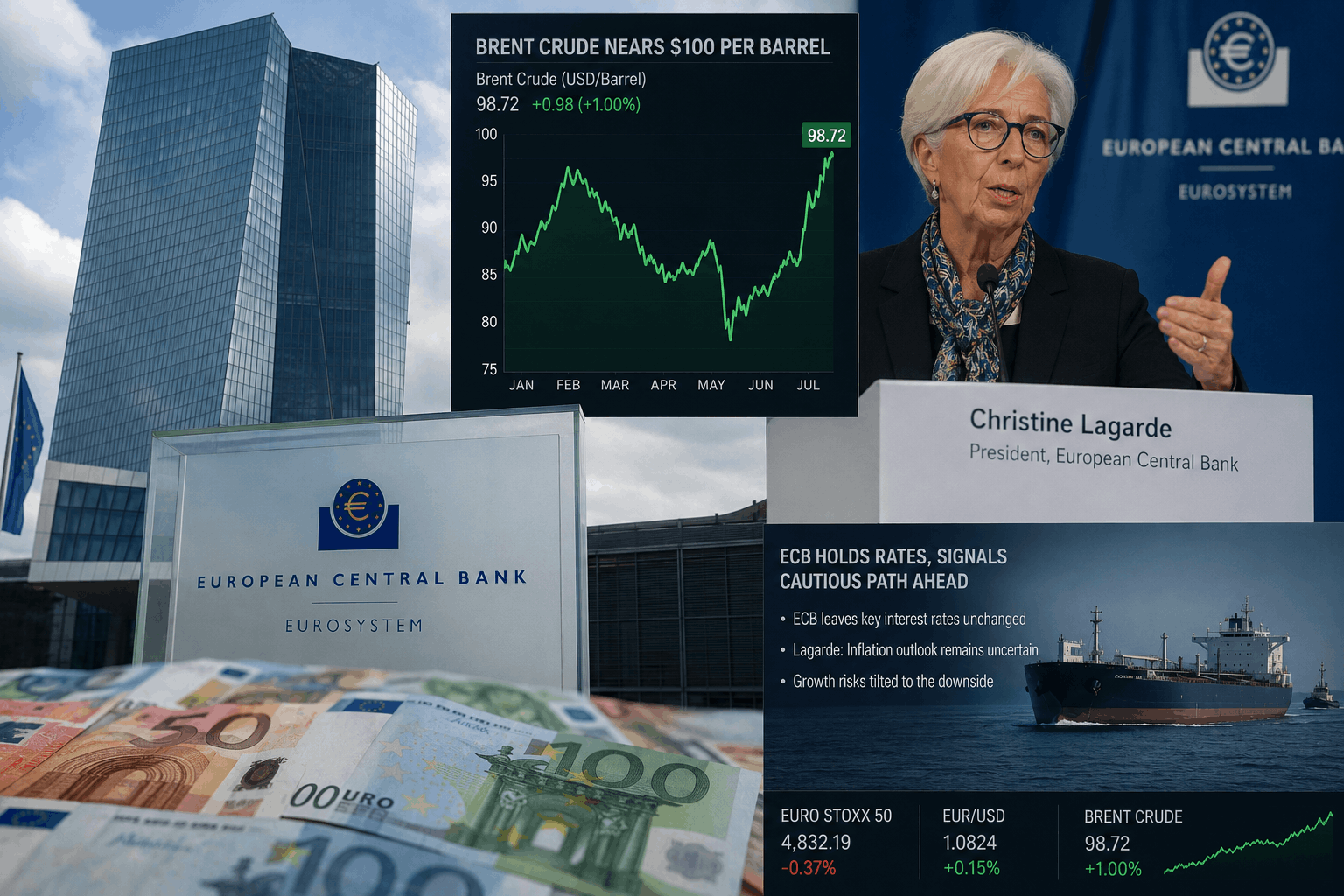
The European Central Bank kept interest rates unchanged at its July meeting but emphasized that renewed energy-price pressures and geopolitical risks could warrant further policy tightening if inflation proves more persistent.
Entities
Organizations
European Central Bank (ECB)
People
Christine Lagarde
Indexes
STOXX Europe 600
Industries
Banking
Energy
Financial Services
Utilities
Consumer Goods
Technology
Technologies
None
Key Takeaways
The ECB left its deposit facility rate unchanged at 2.25%, following a 25-basis-point increase in June.
Policymakers emphasized that future decisions will remain data dependent while closely monitoring energy prices and geopolitical developments.
Rising oil and natural gas prices have emerged as the principal new inflation risk facing the euro area.
Financial markets interpreted the ECB's communication as keeping the possibility of another rate increase at the September meeting.
European equities declined while bond yields remained elevated as investors reassessed the outlook for inflation and monetary policy.
Article
ECB pauses rate hikes but warns energy inflation could revive tightening cycle
The European Central Bank (ECB) left its key interest rates unchanged at its July policy meeting, maintaining the deposit facility rate at 2.25% while signaling that renewed inflation pressures from higher energy prices could require further monetary tightening in the months ahead.
The decision was widely anticipated by financial markets after the ECB raised rates by 25 basis points in June. However, policymakers used the meeting to stress that the recent surge in oil and natural gas prices, coupled with heightened geopolitical uncertainty, has introduced new risks to the inflation outlook even as underlying economic activity remains subdued.
The central bank reiterated that future policy decisions will continue to be guided by incoming economic data rather than a predetermined path, leaving investors focused on whether September could bring another interest-rate increase.
ECB opts for caution after June increase
The July meeting represented a pause rather than a reversal of the ECB's tightening stance.
By keeping rates unchanged, policymakers acknowledged recent signs that inflation and wage growth have moderated while also recognizing that the euro area's economic recovery has yet to gain meaningful momentum.
Reuters reported that officials concluded the available data did not justify another immediate increase, particularly given elevated uncertainty surrounding the conflict in the Middle East and its potential impact on global energy markets.
Instead, the Governing Council chose to monitor how recent developments affect inflation before determining whether additional policy action becomes necessary.
The decision reflects the increasingly delicate balance facing the ECB as it seeks to return inflation sustainably to its target without placing unnecessary pressure on an already slowing economy.
Energy prices become the central inflation risk
Although underlying inflation pressures have shown signs of easing in recent months, policymakers identified rising energy costs as the most significant new threat to price stability.
Brent crude oil has returned to around $100 per barrel, reversing part of the decline in energy prices that had contributed to improving inflation trends across Europe.
At the same time, European natural gas prices climbed to their highest level in more than three years, raising concerns that higher wholesale energy costs could eventually reach households and businesses.
The renewed increase in energy prices has been driven largely by escalating geopolitical tensions, including attacks on commercial shipping routes in the Middle East that have disrupted oil transportation and increased concerns about future supply availability.
For the ECB, the key question is not simply whether energy prices rise, but whether those increases persist long enough to influence broader inflation throughout the economy.
Policymakers monitor second-round inflation effects
The ECB emphasized that it is closely evaluating both the intensity and duration of the current energy-price shock.
Central banks typically distinguish between temporary increases in commodity prices and more persistent inflationary pressures that spread across the broader economy.
The latter can occur through so-called second-round effects.
Higher fuel costs often increase transportation expenses, manufacturing costs, logistics charges, and utility bills.
Businesses may eventually pass those higher operating costs on to consumers through increased prices.
Workers, facing higher living expenses, may also seek larger wage increases, potentially creating a cycle in which higher wages and higher prices reinforce one another.
These indirect effects tend to be of greater concern to central banks than short-term fluctuations in commodity markets because they can make inflation more persistent.
ECB officials indicated they are closely monitoring whether recent energy price increases begin affecting wages, production costs, transportation expenses, and broader consumer prices across the euro area.
Lagarde emphasizes flexibility
ECB President Christine Lagarde reinforced the central bank's cautious approach during her post-meeting remarks.
Lagarde said the ECB is not committing to any predetermined policy path and stressed that future interest-rate decisions will depend entirely on incoming economic data.
She also reaffirmed that the central bank remains committed to returning inflation to its 2% target, despite heightened uncertainty surrounding energy markets and geopolitical developments.
Her comments reflected the Governing Council's preference for maintaining flexibility rather than signaling a specific timetable for future policy changes.
That approach allows the ECB to respond quickly if inflation risks intensify while avoiding unnecessary commitments should economic conditions weaken further.
The emphasis on data dependence has become a defining feature of the ECB's communication strategy as policymakers navigate an increasingly uncertain macroeconomic environment.
Financial markets see September still in play
Although rates remained unchanged, financial markets interpreted the ECB's communication as preserving the possibility of another increase at the September policy meeting.
Investors concluded that the July decision represented a temporary pause rather than confirmation that the tightening cycle has ended.
Expectations for future ECB policy remain highly sensitive to incoming inflation data and developments in energy markets.
Should oil and natural gas prices remain elevated, markets increasingly believe policymakers could resume raising borrowing costs to prevent higher energy expenses from feeding into broader inflation.
Conversely, if energy prices stabilize and inflation continues moderating, the ECB could maintain its current policy stance for a longer period.
As a result, September has become one of the most closely watched meetings on the euro area's monetary policy calendar.
Euro weakens as dollar remains strong
Currency markets also responded to the ECB's announcement.
The euro weakened against the U.S. dollar following the policy decision.
The decline reflected both the ECB's cautious messaging and continued strength in the dollar, which has benefited from safe-haven demand amid heightened geopolitical uncertainty.
Exchange rates are influenced by relative interest-rate expectations.
If investors believe U.S. monetary policy may remain tighter than policy in the euro area, demand for dollar-denominated assets generally increases.
At the same time, uncertainty surrounding energy supplies has encouraged investors to seek traditionally defensive assets, providing additional support for the U.S. currency.
The euro's weakness therefore reflected both monetary policy expectations and broader market risk sentiment.
Bond markets remain cautious
Government bond markets also reflected continued uncertainty.
Euro-area government bond yields remained elevated following the ECB's announcement as investors reassessed the outlook for inflation and future interest rates.
Higher bond yields typically indicate expectations that borrowing costs may remain elevated for longer or that additional policy tightening remains possible.
The persistence of higher energy prices has complicated expectations that inflation would continue easing steadily throughout the remainder of the year.
As a result, fixed-income investors remain cautious about assuming that the ECB has completed its tightening cycle.
European equities retreat
European equity markets also weakened following the policy decision.
The pan-European STOXX 600 index declined approximately 1.3%.
The decline reflected several overlapping factors, including weaker-than-expected corporate earnings, rising oil prices, and the ECB's relatively hawkish communication.
Sector performance varied considerably.
Energy companies generally outperformed as higher crude prices improved earnings prospects for oil and gas producers.
By contrast, technology and consumer-oriented sectors underperformed.
Technology companies often face valuation pressure when interest rates remain elevated because higher discount rates reduce the present value of future earnings.
Consumer-related businesses also remain vulnerable to higher energy costs, which can reduce household purchasing power and increase operating expenses.
The ECB faces a difficult balancing act
The July meeting highlighted the increasingly complex policy environment confronting the ECB.
On one hand, economic activity across the euro area has yet to demonstrate strong, broad-based acceleration.
Inflation and wage data have shown encouraging signs of moderation in recent months, suggesting earlier policy tightening has begun influencing demand.
On the other hand, renewed increases in oil and natural gas prices threaten to slow that progress.
If energy inflation proves temporary, policymakers may be able to maintain current interest rates while allowing previous tightening measures to continue working through the economy.
However, if higher energy costs begin affecting wages, transportation, manufacturing, and consumer prices more broadly, additional policy tightening could become necessary despite modest economic growth.
Balancing those competing risks has become one of the ECB's principal challenges.
Energy markets regain influence over monetary policy
One of the clearest messages from the July meeting is that developments in global energy markets have once again become central to monetary policy discussions.
Earlier declines in oil and gas prices had contributed significantly to improving inflation trends across Europe.
The recent reversal has quickly altered the policy debate.
Central banks generally cannot directly influence commodity prices.
However, they must respond if higher energy costs begin changing inflation expectations or influencing pricing behavior throughout the economy.
The ECB's latest communication reflects that distinction.
Rather than reacting immediately to higher oil prices, policymakers are evaluating whether the current energy shock proves temporary or develops into a more persistent source of inflation.
What investors will watch next
Attention now shifts toward the September ECB meeting and the economic data scheduled for release before then.
Markets will closely monitor euro-area inflation figures, wage growth, business activity surveys, and indicators of consumer demand.
Developments in global energy markets will remain particularly important.
Investors will watch whether Brent crude remains near or above $100 per barrel, whether European natural gas prices continue rising, and whether geopolitical tensions affecting energy supply routes begin to ease.
Government bond yields, the euro, and inflation expectations will also provide insight into how financial markets interpret evolving economic conditions.
For now, the ECB has chosen patience over immediate action.
But its message was unmistakable: the pause should not be interpreted as the end of the tightening cycle. If energy-driven inflation proves more persistent than expected, policymakers remain prepared to respond with additional interest-rate increases in pursuit of their 2% inflation objective.
Disclaimer
This content is for educational and informational purposes only. It is not financial advice. Stratton Journal does not recommend any specific investment or trading strategy.