


Intel Forecast Tops Estimates as AI Infrastructure Demand Powers Earnings Beat
Intel reported stronger-than-expected second-quarter results and issued an upbeat third-quarter forecast, citing robust demand for AI-focused server processors and continued investment in its foundry business.
By Vikram Singh
Key Takeaways
Intel reported second-quarter revenue and earnings that exceeded Wall Street expectations and issued stronger-than-expected guidance for the third quarter.
The company attributed the improvement to robust demand for server CPUs supporting AI infrastructure, particularly emerging "agentic AI" workloads.
Intel raised its 2026 capital expenditure forecast to $20 billion, signaling confidence in long-term AI-driven demand.
Intel Foundry generated $5.77 billion in quarterly revenue while expanding customer commitments for future manufacturing technologies.
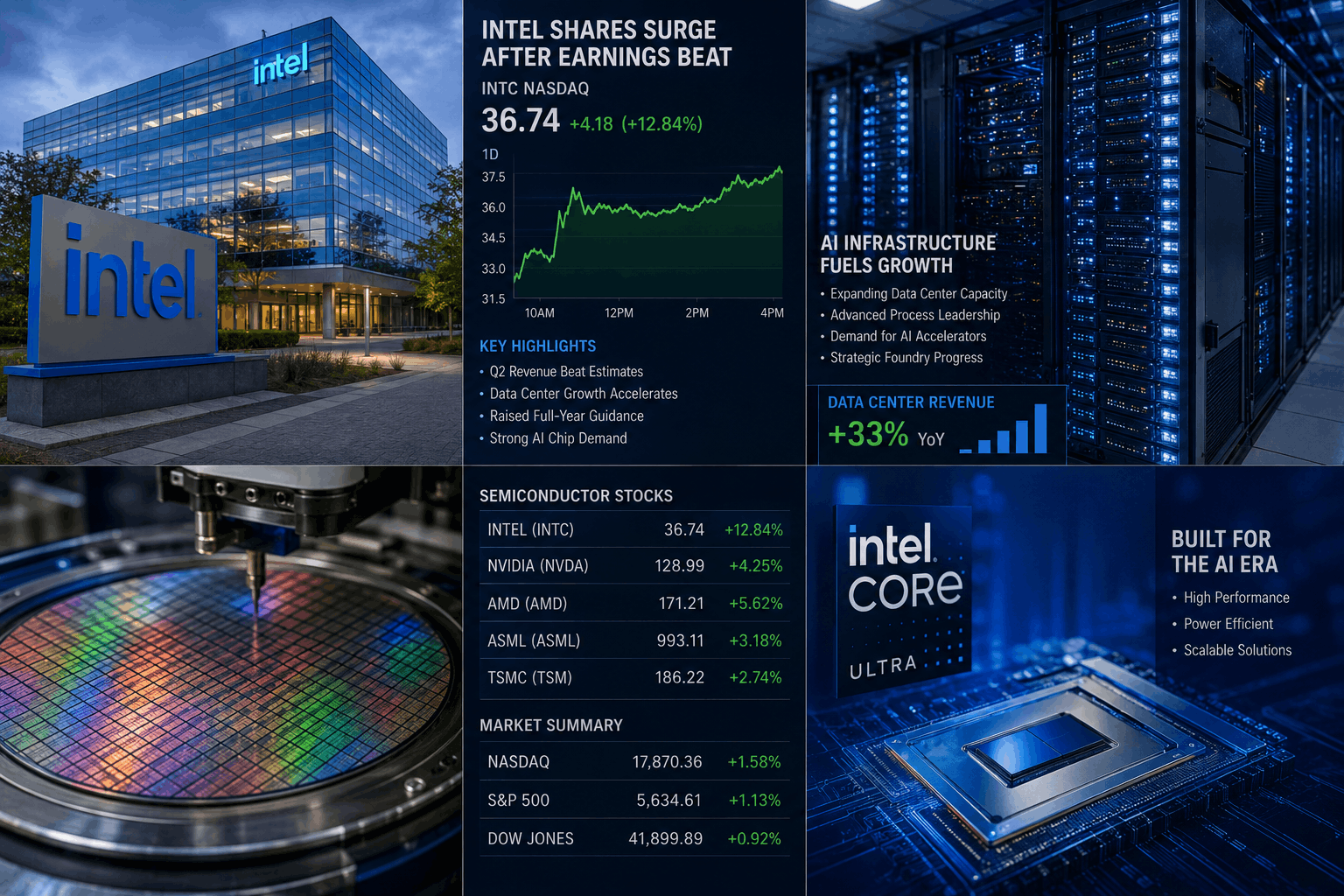
Intel shares rose about 5.2% in after-hours trading, lifting sentiment across the broader semiconductor sector.
Article
Intel beats Wall Street estimates as AI infrastructure fuels stronger outlook
Intel delivered a stronger-than-expected second quarter and raised expectations for the current quarter, signaling that accelerating investment in artificial intelligence infrastructure is beginning to translate into improved financial performance for the U.S. chipmaker.
The company reported quarterly revenue and adjusted earnings that comfortably exceeded Wall Street estimates while issuing third-quarter guidance above analyst expectations. Intel said demand for its server central processing units (CPUs) has remained resilient as enterprises and cloud providers expand computing capacity to support increasingly sophisticated AI applications, including the emerging category of "agentic AI." Reuters reported that the results sent Intel shares about 5.2% higher in after-hours trading, while also supporting gains in other semiconductor stocks.
The earnings report marks another indication that AI-related spending continues to reshape demand across the semiconductor industry, extending beyond graphics processors to include the broader computing infrastructure needed to deploy advanced artificial intelligence systems.
Quarterly results surpass analyst expectations
For the quarter ended June 27, 2026, Intel reported revenue of $16.13 billion, exceeding the $14.42 billion consensus estimate compiled by LSEG.
The company also reported adjusted earnings per share of $0.42, well above analyst expectations of $0.21.
Adjusted gross margin reached 41.8%, compared with expectations of 38.8%.
The results suggested stronger operating performance across several parts of Intel's business, with improved profitability accompanying higher-than-anticipated sales.
The combination of revenue growth and expanding margins indicated that demand for Intel's products remained stronger than many investors had expected despite intense competition across the semiconductor industry.
The earnings beat was particularly significant because investors have closely watched Intel's progress as the company works to regain momentum in data center processors while simultaneously investing heavily in manufacturing expansion and artificial intelligence.
Third-quarter guidance exceeds forecasts
Intel's outlook for the current quarter further strengthened investor confidence.
The company forecast third-quarter revenue between $15.8 billion and $16.8 billion, compared with analysts' consensus estimate of $15.10 billion.
Intel also projected adjusted earnings per share of $0.38, exceeding the market expectation of $0.27.
Guidance often carries significant weight during earnings season because it provides investors with management's assessment of near-term business conditions.
By forecasting both revenue and earnings above consensus estimates, Intel indicated that it expects demand trends to remain favorable through the coming quarter.
The stronger outlook suggested that recent improvements are not limited to a single reporting period but may reflect broader momentum across the company's businesses.
AI infrastructure emerges as the primary growth driver
Intel attributed much of its improved performance to continued expansion in artificial intelligence infrastructure.
The company said demand for server CPUs has remained stronger than previously expected as businesses invest in the computing capacity required to support AI applications.
Unlike consumer AI products, enterprise AI deployments require extensive data center infrastructure capable of processing enormous computational workloads.
While graphics processing units (GPUs) receive much of the attention surrounding AI, central processing units continue to play a critical role in managing, coordinating, and supporting those systems.
Reuters reported that Intel identified the rapid growth of agentic AI as one factor supporting server processor demand.
Agentic AI refers to autonomous software systems capable of independently performing tasks such as coding, workflow management, research, and other complex computing functions with limited human intervention.
These increasingly sophisticated applications require significant computing infrastructure, creating additional demand for high-performance server processors.
As organizations deploy larger AI systems across cloud platforms and enterprise environments, demand for supporting hardware extends beyond specialized AI accelerators to include CPUs, networking equipment, memory, and storage infrastructure.
CFO sees stronger demand than expected
Chief Financial Officer David Zinsner told Reuters that demand for AI-related server processors has remained stronger than the company had anticipated.
His comments suggested that enterprise customers continue expanding infrastructure investments despite broader market concerns about the pace of AI-related capital spending.
The remarks also contrast with recent investor concerns surrounding other major technology companies, where markets have increasingly questioned whether large AI infrastructure investments will generate sufficient financial returns.
Intel's results suggest that at least some segments of the semiconductor industry are already benefiting directly from continued investment in AI computing capacity.
The company's performance provides additional evidence that infrastructure spending remains robust even as investors scrutinize capital allocation more closely across the technology sector.
Intel raises capital spending plans
Reflecting confidence in future demand, Intel increased its planned capital expenditures for 2026.
The company now expects to spend $20 billion during the year, up from its previous forecast of $18 billion.
According to Reuters, Zinsner also indicated that capital spending is expected to increase further in 2027.
Capital expenditures represent long-term investments in manufacturing facilities, production equipment, and infrastructure needed to support future growth.
For semiconductor manufacturers, these investments are particularly significant because advanced chip fabrication requires highly specialized facilities costing tens of billions of dollars.
Intel's decision to increase spending suggests management expects demand to remain sufficiently strong to justify additional investment in production capacity.
The announcement also reinforces the broader industry trend toward expanding manufacturing capabilities as AI-related demand continues growing.
Foundry business continues to expand
Intel also reported progress in its contract manufacturing operations.
The Intel Foundry business generated $5.77 billion in second-quarter revenue, reflecting continued expansion of the company's efforts to manufacture chips for external customers.
Developing a successful foundry business has become one of Intel's central strategic priorities as it seeks to diversify revenue sources beyond designing and selling its own processors.
Reuters reported that Intel secured new long-term customer agreements covering both data center CPUs and specialized AI chips, commonly referred to as XPUs.
The company also announced additional customer engagements involving its next-generation 14A manufacturing process, which is targeted for high-volume production in 2028.
These agreements suggest continued customer interest in Intel's advanced manufacturing roadmap despite intense competition from established contract chip manufacturers.
AI manufacturing strategy takes shape
The expansion of Intel Foundry reflects a broader transformation within the semiconductor industry.
Historically, Intel primarily designed and manufactured chips for its own products.
Under its current strategy, the company is investing heavily to become a major contract manufacturer capable of producing chips designed by other companies.
The foundry model has gained increasing strategic importance as governments and technology companies seek greater geographic diversification in semiconductor manufacturing.
Winning contracts for AI processors and advanced data center chips could become an important long-term growth opportunity if Intel successfully executes its manufacturing roadmap.
Customer engagement around the 14A process represents an early indicator that potential clients continue evaluating Intel's future production technologies.
Market rewards stronger execution
Investors responded positively to Intel's earnings report.
Shares rose approximately 5.2% in after-hours trading following the announcement.
Reuters also reported that the results helped support gains across the broader semiconductor sector, including shares of AMD and Arm Holdings.
The positive reaction reflected investor confidence that Intel's operational improvements and AI-driven demand may continue supporting financial performance.
The market response contrasted with recent volatility surrounding other technology earnings, where investors have become increasingly sensitive to heavy capital spending and weaker free cash flow.
In Intel's case, stronger earnings and improved guidance appeared sufficient to reassure investors that higher investment levels are being supported by growing customer demand.
AI demand broadens across the semiconductor industry
Intel's earnings highlight an increasingly important development in artificial intelligence.
While much investor attention has focused on companies producing AI accelerators and graphics processors, AI infrastructure requires a much broader ecosystem of semiconductor technologies.
Data centers supporting AI workloads require server CPUs, memory, networking equipment, storage systems, electrical infrastructure, and advanced manufacturing capacity in addition to specialized AI chips.
The rise of agentic AI could further expand infrastructure requirements because increasingly autonomous software systems require additional computing resources to manage more complex workloads.
Intel's results suggest that these broader infrastructure investments are creating meaningful opportunities beyond the highest-profile AI chip segments.
Investors will monitor execution
Despite the strong quarter, investors remain focused on Intel's ability to sustain its recent momentum.
Execution against third-quarter guidance will be closely watched as an indicator of whether current demand trends remain durable.
Markets will also monitor continued demand for AI server processors, particularly as enterprises expand AI deployments across cloud and corporate computing environments.
Intel's higher capital expenditure plans for 2026 and anticipated increases in 2027 will remain another important area of focus, with investors evaluating whether additional spending produces corresponding improvements in revenue, margins, and profitability.
Progress within the Intel Foundry business, including customer adoption of the company's 14A manufacturing process and the expansion of long-term manufacturing agreements, will also serve as key indicators of the company's strategic transformation.
For now, Intel's latest earnings report offers one of the clearest signs this earnings season that accelerating AI infrastructure investment is translating into stronger demand for semiconductor hardware. The company's better-than-expected results, optimistic outlook, and increased investment plans suggest management sees continued opportunities as enterprises build the computing foundation required for the next generation of artificial intelligence applications.
Disclaimer
This content is for educational and informational purposes only. It is not financial advice. Stratton Journal does not recommend any specific investment or trading strategy.