
Tesla Shares Fall After Earnings Miss as AI and Robotaxi Spending Clouds Outlook
Tesla reported stronger-than-expected second-quarter revenue and record deliveries, but investors sent shares lower after weaker earnings, negative free cash flow, and sharply higher spending on artificial intelligence and autonomous driving.
By Vikram Singh
Key Takeaways
Tesla exceeded revenue expectations but missed earnings estimates as AI-related spending accelerated.
Capital expenditures surged while free cash flow turned negative amid heavy investment in AI infrastructure and Robotaxi development.
Record vehicle deliveries and strong growth in the energy business helped support revenue.
Investors focused on profitability, cash flow and future AI spending, sending the stock lower in after-hours trading.
Management reiterated that autonomy and robotics remain Tesla's primary long-term growth drivers.
Tesla reported second-quarter 2026 results that topped Wall Street's revenue expectations but missed on earnings, as rising investment in artificial intelligence, autonomous driving and robotics weighed on profitability and investor sentiment.
Revenue increased to approximately $28.24 billion, ahead of analyst forecasts, while adjusted earnings per share came in at about $0.33, below expectations. Although sales improved from a year earlier, net income declined as higher research and development expenses, AI investments and infrastructure depreciation pressured margins.
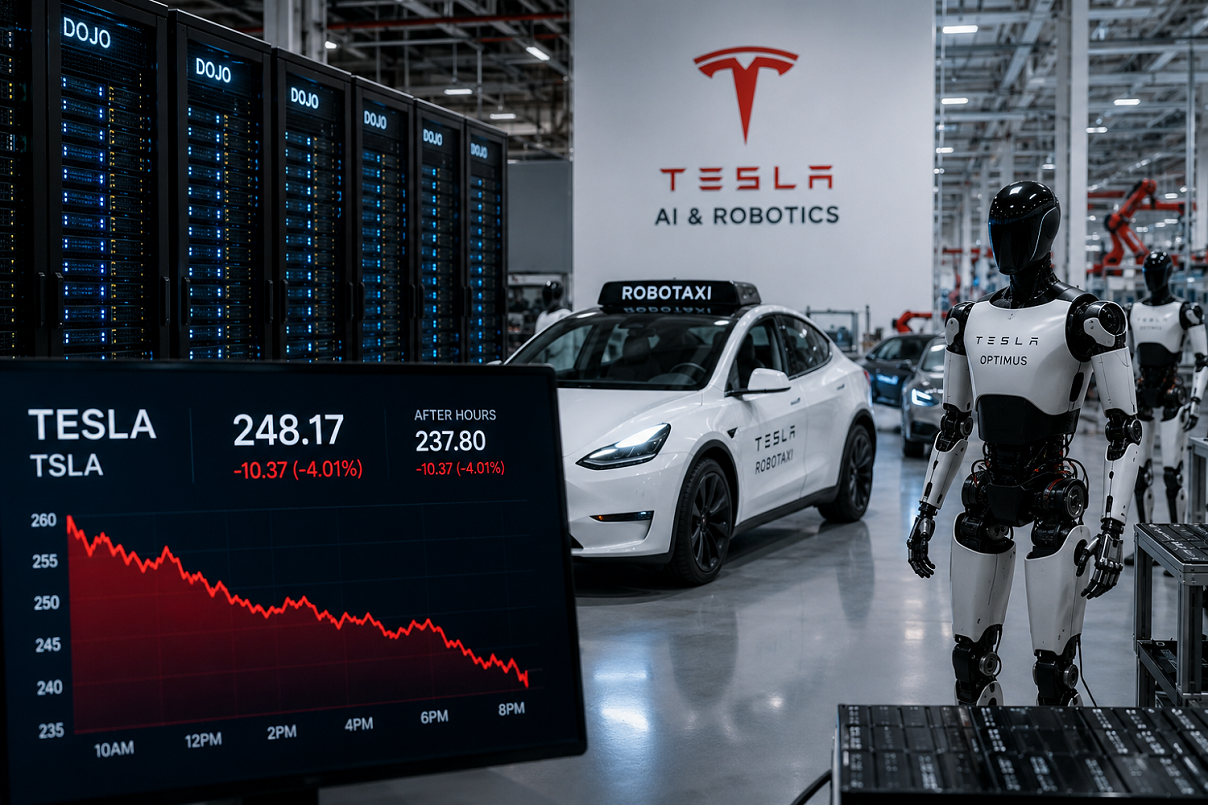
Investors reacted negatively to the results, sending Tesla shares down roughly 4% in after-hours trading as attention shifted from revenue growth to profitability and cash generation.
Research and development spending rose nearly 50% from a year earlier as Tesla accelerated investment in artificial intelligence, autonomous driving software and computing infrastructure. Capital expenditures reached approximately $5.8 billion during the quarter, more than doubling from the prior year, while free cash flow turned negative at roughly $1.1 billion, the company's first negative quarterly free cash flow in more than two years.
Chief Financial Officer Vaibhav Taneja said Tesla now expects 2026 capital expenditures to exceed $25 billion, adding that investment could continue rising over the next several years as the company expands AI training capacity, manufacturing infrastructure and autonomous vehicle programs.
Tesla delivered 480,126 vehicles during the quarter, a record second-quarter total and above Wall Street expectations. Production reached 451,758 vehicles, allowing deliveries to outpace production by more than 28,000 units and reducing inventory levels. Model 3 and Model Y vehicles continued to account for the vast majority of deliveries.
The company's Energy division also continued to expand, deploying approximately 13.5 GWh of energy storage products during the quarter. Management highlighted energy storage as an increasingly important source of revenue diversification alongside its automotive business.
Tesla continued expanding paid subscriptions for its Full Self-Driving software, with global subscriptions approaching 1.5 million. The company also broadened Robotaxi operations into seven U.S. markets, although management emphasized that deployment remains deliberately limited while safety and regulatory requirements continue to guide the rollout.
Chief Executive Elon Musk reiterated that Tesla is evolving beyond an electric vehicle manufacturer into an artificial intelligence and robotics company. He described autonomous driving as a major long-term value driver and said Optimus humanoid robots remain one of Tesla's largest future opportunities, though production is still in its early stages.
The earnings call underscored that investors are increasingly evaluating Tesla using AI and technology metrics rather than traditional automotive measures. Analysts focused heavily on whether the company's growing investments in AI infrastructure, Robotaxi software, Dojo computing systems and robotics will ultimately generate sufficient returns to justify rising capital expenditures.
The results also reinforced a broader trend across the technology sector. Like Alphabet, Microsoft, Amazon and Meta, Tesla is committing substantial resources to AI infrastructure, even as near-term profitability comes under pressure. For investors, the central question has shifted from revenue growth to whether AI monetization can eventually outpace the cost of building the infrastructure required to support it.
Despite healthy revenue growth, record deliveries and continued expansion beyond electric vehicles, Tesla's latest quarter highlighted the trade-off between aggressive long-term investment and short-term financial performance. Management signaled that elevated spending is likely to continue through 2026 as the company pursues leadership in autonomous transportation, artificial intelligence and robotics.
➡️ Read our analysis of Alphabet's earnings:
Alphabet Shares Slip After Strong Earnings as Higher AI Spending Overshadows Results
Disclaimer
This content is for educational and informational purposes only. It is not financial advice. Stratton Journal does not recommend any specific investment or trading strategy.