


U.S. Dollar Rallies as Yen Sinks to 40-Year Low on Oil Surge and Rising Treasury Yields
The U.S. dollar strengthened broadly as higher oil prices, rising Treasury yields, geopolitical tensions, and renewed inflation concerns fueled demand for dollar-denominated assets, while the Japanese yen fell to its weakest level since 1986.
By Vikram Singh
Key Takeaways
The U.S. dollar strengthened as rising Treasury yields, higher oil prices, and geopolitical tensions increased demand for safe-haven assets.
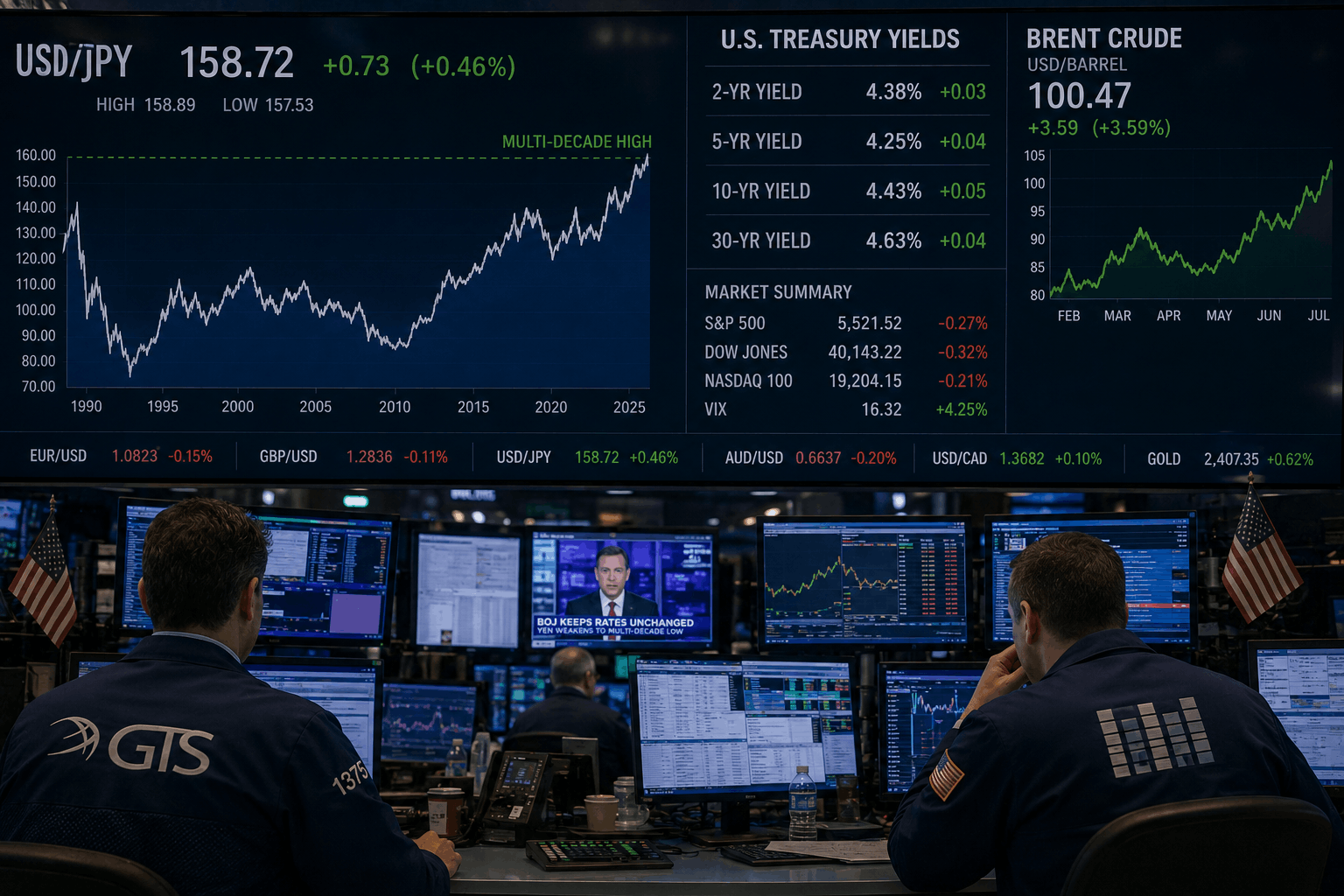
The Japanese yen fell to a fresh 40-year low, reaching its weakest level against the dollar since 1986.
Higher energy prices and widening U.S.-Japan interest-rate differentials continued to pressure the yen.
The euro weakened after the ECB kept interest rates unchanged, while commodity-linked currencies also declined.
Investors closely monitored Treasury yields, Bank of Japan policy, and the possibility of Japanese currency intervention.
Article
Dollar strengthens as oil rally and higher Treasury yields reshape currency markets
The U.S. dollar advanced against most major currencies on Friday as rising oil prices, higher Treasury yields, and escalating geopolitical tensions reinforced demand for dollar-denominated assets, while the Japanese yen fell to its weakest level against the greenback in four decades.
The U.S. Dollar Index climbed to its highest level in about three weeks as investors reassessed the outlook for inflation and interest rates following Brent crude's move above $100 per barrel. The combination of higher energy prices, stronger U.S. bond yields, and growing geopolitical uncertainty encouraged investors to shift toward defensive assets, extending the dollar's recent gains across global foreign exchange markets.
The move underscored how closely currencies remain linked to developments in commodity markets, monetary policy expectations, and international geopolitical events.
Yen falls to weakest level since 1986
The Japanese yen remained the primary casualty of the latest shift in global market sentiment.
The currency weakened to a fresh 40-year low against the U.S. dollar, marking its weakest exchange rate since 1986.
Several structural and cyclical factors combined to pressure the yen.
The most significant remains the large interest-rate differential between the United States and Japan.
U.S. interest rates continue to stand substantially above Japanese borrowing costs, encouraging global investors to move capital into higher-yielding dollar-denominated assets.
When interest-rate gaps widen, international investors often find U.S. Treasury securities and other dollar assets more attractive than lower-yielding Japanese investments.
That capital flow tends to strengthen the dollar while placing sustained downward pressure on the yen.
The latest increase in Treasury yields further reinforced that dynamic.
Oil prices add another challenge for Japan
The surge in energy prices has created additional pressure on Japan's currency.
Japan imports the overwhelming majority of its oil and natural gas requirements, making the economy particularly sensitive to increases in global energy prices.
Brent crude trading above $100 per barrel raises the country's import bill, increasing demand for foreign currency to pay for energy purchases.
Higher energy import costs can also worsen Japan's trade balance if export growth fails to offset rising fuel expenditures.
As importers purchase additional dollars to settle international energy transactions, demand for the U.S. currency increases while pressure on the yen intensifies.
This relationship becomes particularly significant during periods of elevated oil prices.
The latest rise in crude prices therefore contributed to yen weakness through both inflation expectations and Japan's external financing requirements.
Treasury yields support the dollar
Rising U.S. Treasury yields provided another important source of support for the dollar.
Benchmark Treasury yields moved higher as investors concluded that renewed increases in oil prices could make inflation more persistent than previously anticipated.
Higher bond yields generally increase the attractiveness of dollar-denominated investments because investors receive greater returns from holding U.S. government securities.
As global capital flows toward those higher yields, demand for the dollar typically strengthens.
The relationship between Treasury yields and the U.S. dollar has remained one of the defining features of foreign exchange markets over the past several years.
The latest move reinforced that pattern, with yields and the dollar rising together as markets reassessed the likely path of U.S. monetary policy.
Inflation concerns reshape market expectations
The surge in crude oil prices has revived concerns that inflation could remain elevated for longer than investors had expected.
Higher energy prices can influence inflation through multiple channels.
More expensive oil generally increases transportation costs, manufacturing expenses, logistics charges, and consumer fuel prices.
If businesses pass those higher costs to customers, broader inflation measures may begin rising again.
Financial markets therefore interpreted the latest oil rally as increasing the likelihood that central banks could maintain tighter monetary policy for longer.
Reduced expectations for near-term interest-rate easing provided additional support for Treasury yields and the U.S. dollar.
The combined effect of higher oil prices and higher bond yields strengthened the dollar's appeal relative to lower-yielding currencies.
Geopolitical tensions reinforce safe-haven demand
Beyond inflation, geopolitical developments also encouraged investors to seek traditionally defensive assets.
Escalating tensions in the Middle East, including attacks affecting commercial shipping routes, increased uncertainty surrounding global energy supplies.
Periods of geopolitical stress frequently benefit the U.S. dollar because of its role as the world's primary reserve currency and the deep liquidity of U.S. financial markets.
Institutional investors often increase allocations to dollar-denominated assets during episodes of elevated uncertainty.
The latest currency movements reflected that familiar pattern.
Safe-haven demand complemented the support already being provided by higher Treasury yields and inflation expectations.
Trade policy adds another inflation consideration
Investor sentiment was also influenced by trade developments.
President Donald Trump announced new tariffs on goods imported from 60 countries over forced-labor concerns.
Markets viewed the measures as another potential source of inflationary pressure because tariffs can increase the cost of imported goods.
Higher import prices may ultimately feed into consumer inflation if businesses pass those additional costs to customers.
The tariff announcements therefore reinforced expectations that inflation risks remain skewed to the upside.
That perception further supported the dollar by strengthening expectations that U.S. monetary policy could remain relatively restrictive.
The combination of energy-related inflation and trade-related cost pressures became another important theme in currency markets.
Euro weakens following ECB decision
The euro also declined against the dollar.
Its weakness followed the European Central Bank's decision to leave interest rates unchanged while maintaining a data-dependent policy stance.
Although the ECB left open the possibility of future tightening should inflation pressures intensify, the combination of steady rates and broad dollar strength weighed on the common currency.
The euro's decline reflected both relative monetary policy expectations and the stronger demand for dollar assets across global markets.
Exchange rates are often determined by differences in expected interest-rate paths between major central banks.
With U.S. yields remaining elevated and safe-haven demand supporting the dollar, the euro struggled to gain traction despite the ECB's continued vigilance regarding inflation.
Commodity-linked currencies also retreat
The shift toward defensive positioning extended beyond Europe and Japan.
Commodity-linked currencies, including the Australian and New Zealand dollars, weakened modestly against the U.S. currency.
These currencies often respond to changes in global growth expectations and investor risk appetite.
Although higher commodity prices can sometimes support resource-exporting economies, the broader move toward safe-haven assets outweighed those positive effects during the session.
The stronger dollar also contributed to pressure across several emerging-market currencies.
A rising dollar can tighten global financial conditions by increasing borrowing costs for countries and companies with dollar-denominated debt.
As a result, the currency's appreciation has implications extending well beyond developed foreign exchange markets.
Dollar strength carries broader economic implications
Movements in exchange rates influence a wide range of economic activity.
A stronger dollar generally makes imported goods less expensive for U.S. consumers but increases the local-currency cost of commodities such as oil for many foreign buyers because most international energy transactions are denominated in dollars.
The appreciation of the dollar can also affect multinational corporations.
Companies generating significant overseas revenue may experience less favorable earnings translation when foreign-currency income is converted back into dollars.
Conversely, importers may benefit from lower costs on goods purchased abroad.
The currency's movements therefore influence corporate earnings, international trade, inflation, and financial conditions simultaneously.
Attention turns to Japan's policy response
With the yen at its weakest level in four decades, investors increasingly focused on the possibility of official action.
Market participants monitored comments from the Bank of Japan for indications of future monetary policy adjustments.
The U.S. Treasury Department stated that excessive volatility in the yen was undesirable and encouraged the Bank of Japan to continue normalizing monetary policy.
Treasury officials suggested that further BOJ interest-rate increases could help anchor inflation expectations while reducing exchange-rate volatility.
Although no immediate intervention was announced, investors remained alert to the possibility that Japanese authorities could respond if currency movements become increasingly disorderly.
Historically, rapid depreciation of the yen has occasionally prompted official intervention in foreign exchange markets.
Markets remain focused on several key indicators
Currency traders continue monitoring several closely linked indicators.
The USD/JPY exchange rate remains the primary measure of pressure on the Japanese currency.
The U.S. Dollar Index provides a broader indication of overall dollar strength.
Treasury yields continue serving as one of the most influential drivers of currency valuations because they shape international capital flows and interest-rate expectations.
At the same time, Brent crude prices remain critical because sustained oil prices above $100 per barrel could reinforce inflation concerns and further influence central-bank policy decisions.
Investors are also watching future communications from the Bank of Japan, the European Central Bank, and the Federal Reserve for signals regarding the path of interest rates.
Dollar benefits from a convergence of macroeconomic forces
The latest advance in the U.S. dollar illustrates how multiple macroeconomic forces can reinforce one another.
Higher oil prices revived inflation concerns.
Inflation expectations pushed Treasury yields higher.
Higher yields attracted global capital into dollar-denominated assets.
Geopolitical uncertainty increased safe-haven demand.
Trade policy developments added another source of potential inflation pressure.
Together, these factors created broad support for the U.S. currency while weighing on lower-yielding and more economically sensitive currencies.
For now, foreign exchange markets remain focused on whether oil prices stay elevated, whether Treasury yields continue rising, and whether central banks adjust policy in response to renewed inflation risks.
The interaction among energy markets, bond yields, monetary policy, and geopolitical developments is likely to remain one of the dominant themes shaping global currency markets in the weeks ahead.
Disclaimer
This content is for educational and informational purposes only. It is not financial advice. Stratton Journal does not recommend any specific investment or trading strategy.